

Sending emails to Canadian audiences? You need to know about Canada’s Anti-Spam Legislation (CASL). This law doesn’t just protect consumers – it directly affects your email deliverability and sender reputation. Here’s what you should know:
- Consent is mandatory: You need express or implied consent before sending emails.
- Clear identification: Every email must include your business name and contact details.
- Unsubscribe options: Recipients must be able to opt out easily, and requests must be processed within 10 business days.
- Penalties are steep: Fines can reach up to $10 million for businesses.
- Benefits of compliance: Better email list quality, fewer spam complaints, and improved inbox placement.
Failing to comply can lead to blocklisting, high complaint rates, and financial penalties. On the flip side, CASL compliance ensures your emails reach engaged recipients, boosting trust and performance. Tools like MailMonitor can help by verifying email lists, monitoring reputation, and ensuring legal compliance. Follow CASL not just to avoid fines but to improve your email marketing results.
What Are The Most Important Things To Know About CASL? – TheEmailToolbox.com
How CASL Compliance Affects Email Deliverability
CASL compliance plays a critical role in ensuring your emails land in inboxes rather than being flagged or ignored. It directly impacts sender reputation and inbox placement by influencing bounce rates and recipient engagement. Beyond meeting legal requirements, it also sets the stage for better email performance, which is essential for maintaining trust with Internet Service Providers (ISPs) and consistent email delivery.
Better List Quality and Fewer Spam Complaints
By requiring explicit consent, CASL ensures that your email list consists of genuinely interested recipients. This reduces the risk of spam complaints and leads to better inbox placement. When users opt in through clear, affirmative actions – rather than pre-checked boxes or purchased lists – it results in a cleaner, more trustworthy database that ISPs are more likely to favor [2].
"By adhering to its strict consent, identification, and unsubscribe requirements, your organization establishes a competitive advantage that directly impacts inbox placement." – Jennie Clarke, Head of Content, Global Relay [2]
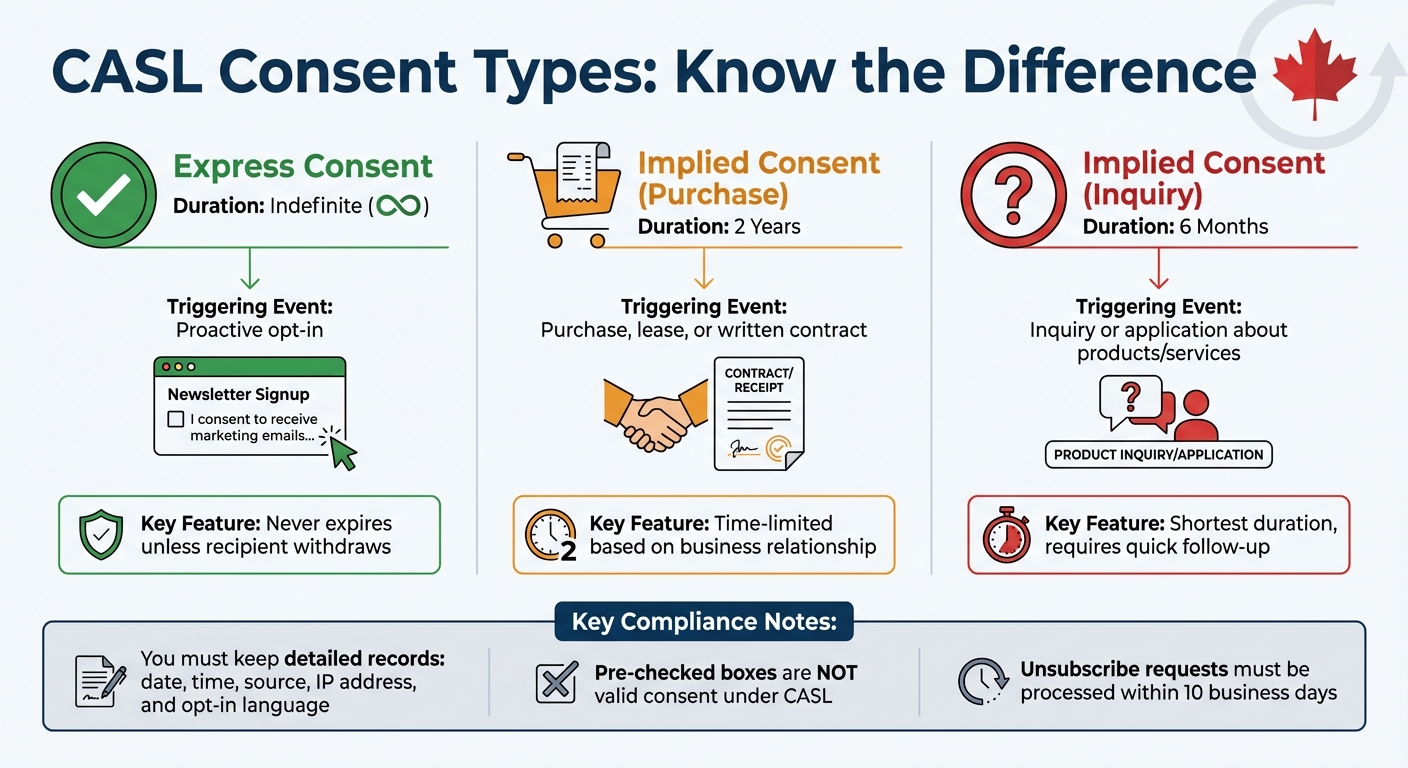
Explicit consent also minimizes spam complaints, which can be a significant issue – 20% of such complaints stem from ignored unsubscribe requests [6]. It’s worth noting that explicit consent remains valid indefinitely, while implied consent has a time limit: 24 months for purchases and 6 months for inquiries [2][4]. While Campaign Monitor reports average delivery rates of 99%, actual inbox placement still depends heavily on sender reputation and recipient engagement [7].
While compliance improves list quality, ignoring CASL requirements can lead to serious consequences.
Non-Compliance Penalties and Deliverability Problems
Failing to comply with CASL can result in severe penalties, including blocklisting and financial loss. Sending emails without proper consent or delaying unsubscribe requests can lead to blocklisting, where ISPs refuse to deliver your emails altogether [6][8]. High complaint rates from non-compliant practices further harm your sender reputation, making it even harder for your emails to reach their destination [7].
Additionally, using harvested or purchased email lists – both of which are prohibited under CASL and PIPEDA – leads to issues like high bounce rates and spam traps, which can devastate deliverability [7][1]. Penalties for violations have been steep, with fines reaching up to $250,000 in 2025 [2]. Beyond fines, the real cost often comes in the form of lost revenue when emails fail to reach their intended audience.
"All the email marketing in the world doesn’t do any good if emails aren’t being delivered." – Kasey Steinbrinck, Author, Email on Acid [6]
How to Comply with CASL and Improve Deliverability
CASL Consent Types: Duration and Requirements for Canadian Email Marketing
Following CASL regulations not only ensures compliance but also helps maintain a strong sender reputation and better inbox placement. By capturing consent, honoring unsubscribe requests, and segmenting your lists, you build trust with recipients and internet service providers (ISPs).
Getting and Keeping Explicit Consent
To maintain high deliverability rates, you need to focus on building quality email lists with explicit consent. Explicit consent involves a clear, affirmative action by the recipient, like manually checking an unchecked opt-in box [4][5]. CASL prohibits pre-checked boxes because they assume consent rather than actively obtaining it [5]. As the sender, you’re responsible for keeping detailed, verifiable records of consent, including the date, time, source, IP address, and the exact language used during the opt-in process [2].
Using a double opt-in process is highly effective. After someone fills out a signup form, send a confirmation email requiring them to verify their subscription. This method not only ensures consent but also filters out fake or mistyped email addresses [2].
To stay compliant, set up automated suppression workflows to remove recipients whose implied consent has expired [2]. One key rule to remember: never send an email asking for consent unless you already have implied consent. Doing so would itself count as a Commercial Electronic Message (CEM) under CASL [4].
Setting Up Effective Unsubscribe Processes
An easy-to-use unsubscribe process is just as important as verified consent. Every commercial email must include a working unsubscribe mechanism that processes requests within 10 business days [4][9][2]. Making it simple for recipients to opt out protects your sender reputation because spam complaints harm deliverability far more than unsubscribes [9]. Interestingly, 20% of Canadians who filed complaints with the CRTC said they continued to receive emails more than 10 days after unsubscribing [6].
"The easier you make it to leave, the less likely people are to report you as spam. Spam complaints hurt your sender reputation more than unsubscribes." – SendCheckIt [9]
Whenever possible, implement one-click unsubscribe. Avoid requiring logins, CAPTCHAs, or multi-step processes [9][5]. The unsubscribe link must work for at least 60 days after the email is sent [9]. Once someone opts out, remove their address from all your mailing lists immediately and ensure it’s not added to another list [9][2]. While you can send a final confirmation email acknowledging the unsubscribe, this email must not include any marketing content or attempts to persuade the recipient to stay [9].
Segmenting Lists for Canadian Recipients
To comply with CASL while maintaining deliverability, it’s important to segment your email lists for Canadian audiences. By creating a dedicated segment for Canadian subscribers, you can apply CASL’s stricter standards without affecting your global campaigns [6][8]. Within this segment, further divide recipients based on their type of consent – express consent (which doesn’t expire) and implied consent (which is time-limited) [4][2].
Keep metadata that tracks the date and method of consent. This allows you to automatically move subscribers from "active" to "suppressed" status when their implied consent expires [4][2]. If you’re working with third-party vendors to send emails, ensure they’ve obtained proper consent for Canadian recipients. As the sender, you’re still responsible for any CASL violations, even when using external services [1][2].
| Consent Type | Duration | Triggering Event |
|---|---|---|
| Express Consent | Indefinite | Proactive opt-in (e.g., newsletter signup) |
| Implied (Purchase) | 2 Years | Purchase, lease, or written contract |
| Implied (Inquiry) | 6 Months | Inquiry or application about products/services |
Regularly cleaning your email lists by removing unresponsive or outdated addresses is essential for maintaining a strong sender reputation and avoiding blocklists [6][8].
sbb-itb-eece389
MailMonitor Tools for CASL Compliance and Deliverability

Stay on top of CASL compliance and safeguard your email reputation with MailMonitor’s specialized tools. These features are designed to help businesses align with Canadian anti-spam laws while ensuring their emails consistently land in inboxes. By integrating these tools with the strategies covered earlier, you can maintain compliance and improve email deliverability.
Inbox Placement Testing and Reputation Monitoring
MailMonitor’s inbox placement testing helps you spot deliverability issues before they harm your campaigns. Non-compliance can lead to blocklisting, but seed list testing across Canadian and global ISPs can identify filtering problems early – before your emails are sent to a wider audience.
With reputation monitoring, MailMonitor keeps an eye on your sender score and flags any patterns of complaints that could be tied to CASL violations. Since the Canadian Radio-television and Telecommunications Commission (CRTC) investigates companies based on consumer complaints about unsolicited messages [8][3], early detection gives you the chance to fix problems before they escalate. Additionally, MailMonitor’s blacklist monitoring instantly notifies you if your domain or IP gets flagged in reputation databases, allowing for quick action to avoid major deliverability setbacks.
Email Verification and List Management
A clean email list is essential for both CASL compliance and better deliverability. MailMonitor’s email verification tool removes invalid addresses and hard bounces, keeping your bounce rate below the critical 2% threshold necessary to protect your sender reputation [10]. High bounce rates can trigger spam filters, making it harder for your emails to reach their intended audience.
This verification process ensures that only recipients who have given consent remain on your Canadian email lists, directly supporting the list quality standards discussed earlier. Pairing this with strong DMARC authentication enhances sender identity security and further improves deliverability.
DMARC Authentication and Compliance Audits
CASL compliance isn’t just about managing your list – it’s also about securing your sender identity. MailMonitor’s DMARC authentication ensures that your emails are verified as legitimate, reducing the chances of spoofing and increasing the likelihood of inbox placement. ISPs are more likely to trust authenticated emails, which is critical for CASL-compliant campaigns.
MailMonitor also offers managed services that audit your consent, unsubscribe, and list management processes. These audits identify potential compliance gaps before they lead to costly penalties, which can reach $1,000,000 for individuals and $10,000,000 for businesses [6][2][9]. The managed services team can also assist with blocklist removal, IP warm-up for new sending setups, and ongoing consultation to ensure both compliance and top-tier deliverability.
| Feature | CASL Compliance Benefit | Deliverability Impact |
|---|---|---|
| DMARC Monitoring | Confirms sender identity and prevents spoofing | Lowers chances of emails being rejected or flagged |
| Reputation Tracking | Detects complaints that could lead to blacklisting | Protects sender score and improves inbox rates |
| Seed List Testing | Identifies delivery issues with Canadian/global ISPs | Catches ISP-specific filtering problems early |
| Email Verification | Keeps lists clean and avoids spam traps | Reduces bounce rates and improves deliverability |
| Blacklist Monitoring | Alerts you to non-compliance-related reputation issues | Enables quick corrective action to avoid failures |
Key Takeaways
Staying compliant with CASL (Canada’s Anti-Spam Legislation) does more than just keep you on the right side of the law – it directly improves email deliverability. By focusing on explicit consent and maintaining clean email lists, CASL pushes marketers to engage with audiences who actually want their messages. This approach leads to higher open rates, fewer spam complaints, and a stronger sender reputation. It’s clear that compliance isn’t just a legal box to check – it’s a smart marketing strategy.
The financial stakes for non-compliance are high. Violations can lead to hefty fines, and repeated issues could get you blocklisted, cutting off your ability to reach inboxes altogether [6].
MailMonitor simplifies the process of staying CASL-compliant. Here’s how:
- Email Verification: Keeps your lists clean by removing invalid or outdated addresses.
- Inbox Placement Testing: Spots potential deliverability issues before your campaign goes live.
- DMARC Authentication: Protects your sender identity from spoofing.
- Reputation Monitoring: Alerts you to patterns that could signal compliance problems.
- Managed Services: Audits consent records and helps transition to express consent, which remains valid until a recipient withdraws it.
Another helpful feature is automated suppression workflows. These ensure you promptly remove recipients who opt out or whose implied consent has expired – typically after 2 years for business relationships or 6 months for inquiries [2][6].
FAQs
What are the penalties for violating CASL regulations?
Non-compliance with Canada’s Anti-Spam Legislation (CASL) comes with hefty consequences. Violations can result in fines as high as $10,000,000 per offense, and responsibility doesn’t stop at the organization – it extends to individuals, including directors and officers, who are accountable for the messages sent under their watch.
Canadian authorities enforce these rules to push businesses toward ethical email practices and compliance. Beyond avoiding massive fines, following CASL helps safeguard your sender reputation and ensures strong email deliverability rates.
How does following CASL regulations enhance email deliverability?
Following CASL (Canada’s Anti-Spam Legislation) is about more than just meeting legal requirements – it’s a smart move for maintaining a strong sender reputation and ensuring your emails actually get delivered.
CASL requires you to get explicit consent from recipients, clearly identify yourself as the sender, and include an easy-to-use unsubscribe option. These steps make your emails more welcome and less likely to be marked as spam.
When your emails are seen as trustworthy, it leads to fewer spam complaints, better engagement rates, and improved inbox placement. All of these factors play a big role in making sure your messages reach the people you’re trying to connect with.
What’s the difference between express and implied consent under CASL?
Under CASL (Canada’s Anti-Spam Legislation), express consent happens when someone actively agrees to receive commercial emails. This usually involves a clear, deliberate action – like signing up through a form or checking a box. Express consent can be provided either in writing or verbally, but it must be explicit and leave no room for doubt.
Implied consent, however, applies in more specific scenarios. For instance, if there’s already an existing business relationship, or if someone has made their email address publicly available in a way that suggests they’re open to being contacted, consent can be inferred. That said, implied consent often comes with a time limit, meaning businesses may need to follow up to secure express consent for continued communication.

