

Email marketing can deliver an impressive ROI – $42 for every $1 spent. But ignoring global email laws could lead to massive fines and hurt your email deliverability. Here’s what you need to know about seven key regulations:
- GDPR (EU): Requires strict opt-in consent. Fines up to €20M or 4% of global revenue.
- CAN-SPAM (US): Opt-out allowed but must honor unsubscribes within 10 business days. Penalties up to $53,088 per email.
- CASL (Canada): Demands explicit or implied opt-in consent. Fines up to $10M CAD.
- PECR (UK): Opt-in required for individuals, with exceptions for "soft opt-ins." Fines up to £500,000 or more under UK GDPR.
- Australian Spam Act: Opt-in required. Unsubscribes must be processed within 5 working days. Fines can reach $1.1M AUD/day.
- LGPD (Brazil): Opt-in or legitimate interest required. Fines up to 2% of revenue, capped at R$50M per violation.
- DPDP (India): Explicit opt-in required. Violations can result in fines up to ₹250 crore (~$30M USD).
Quick Comparison
| Law | Region | Consent Type | Unsubscribe Deadline | Max Penalty (Approx.) |
|---|---|---|---|---|
| GDPR | EU | Strict Opt-in | Promptly (no fixed) | €20M or 4% of global revenue |
| CAN-SPAM | US | Opt-out | 10 business days | $53,088 per email |
| CASL | Canada | Opt-in | 10 business days | $10M CAD |
| PECR / UK GDPR | UK | Opt-in | Promptly (no fixed) | £500K+ (£17.5M under UK GDPR) |
| Spam Act | Australia | Opt-in | 5 working days | $1.1M AUD/day |
| LGPD | Brazil | Opt-in | Promptly (no fixed) | 2% revenue (max R$50M) |
| DPDP | India | Explicit Opt-in | No fixed days | ₹250 crore (~$30M USD) |
To stay compliant, aim for the strictest standards (e.g., GDPR, CASL). Always get clear consent, include sender details, and provide easy unsubscribe options. Automating processes like unsubscribes and using tools like MailMonitor can help ensure compliance and protect your email deliverability.
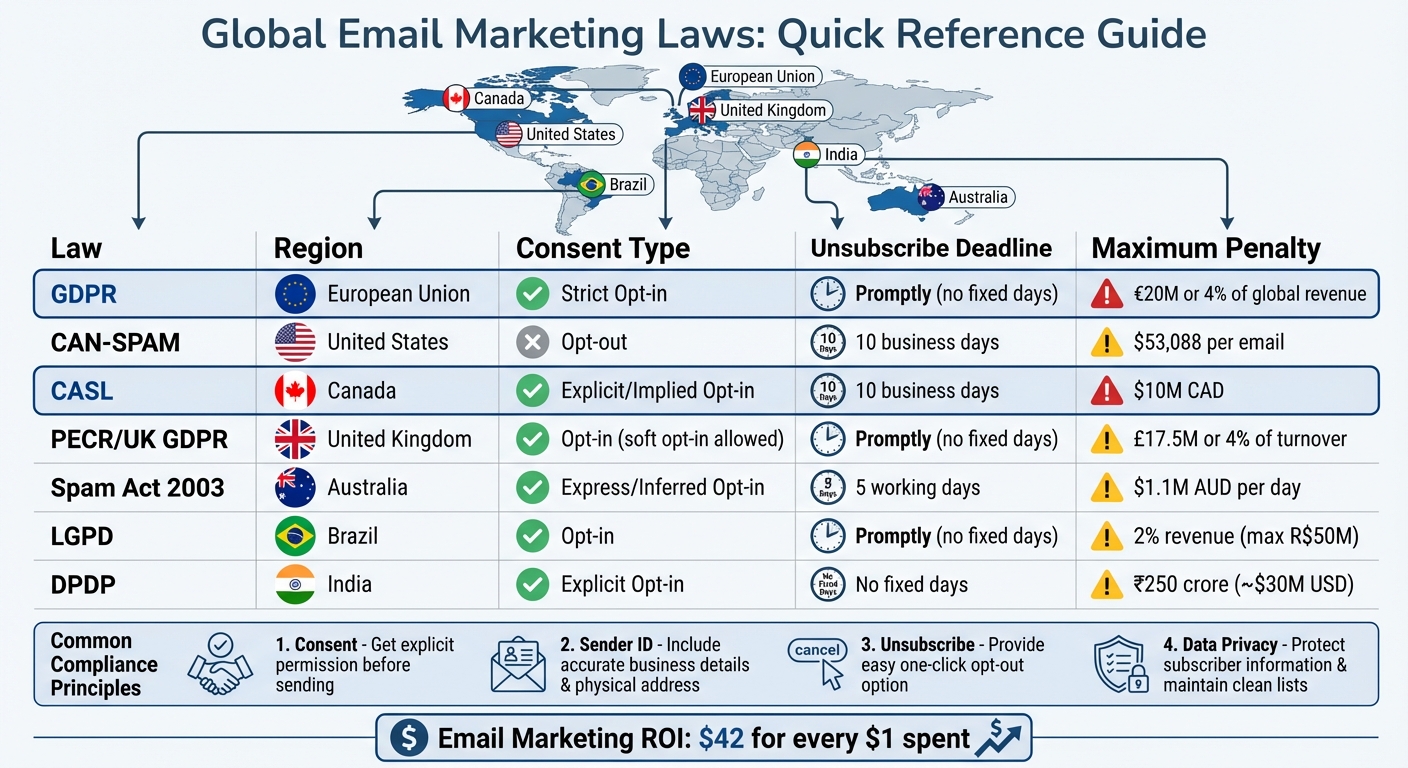
Global Email Marketing Laws Comparison: Consent Requirements and Penalties by Region
What Are The Legal Guidelines For Sending Promotional Emails? – TheEmailToolbox.com
Common Principles Across Email Marketing Laws
No matter where you’re sending emails, most email marketing laws revolve around four key principles: consent, sender identification, unsubscribe options, and data privacy protections. By understanding these shared requirements, you can create a compliance strategy that works across borders while also improving your email deliverability. These principles form the backbone of comparing how different laws influence email practices. Following them doesn’t just keep you on the right side of the law – it also boosts your chances of landing in your subscribers’ inboxes.
Consent is the cornerstone. Most global regulations – like GDPR, CASL, LGPD, and Australia’s Spam Act – require explicit opt-in, meaning subscribers must actively agree to receive your emails, often by ticking an unchecked box [2][1]. The United States takes a different approach with the CAN-SPAM Act, which allows opt-out practices: you can send emails without prior consent, but you must provide a clear way for recipients to unsubscribe and ensure honest sender information [2][3]. While double opt-in is legally required only in Germany and Austria, it’s widely considered a best practice. It confirms genuine interest and helps safeguard your sender reputation [2][1].
Sender identification fosters trust and credibility. Email regulations require you to include accurate sender details and a valid physical address in your email footer [7][3]. This transparency reassures recipients that your emails are legitimate, reducing the risk of being mistaken for phishing attempts. In fact, poor sender reputation accounts for 83% of emails failing to reach inboxes, according to ReturnPath [7]. Additionally, major providers like Gmail and Yahoo now demand technical authentication – using SPF, DKIM, and DMARC – for bulk email senders. So, proper sender identification isn’t just about compliance; it’s critical for deliverability [2].
Clear unsubscribe options safeguard your reputation. All major email laws require a simple way for recipients to opt out of future emails. A one-click unsubscribe option is especially important – it prevents frustrated users from marking your messages as spam. High complaint rates (above 0.3%) can lead to email providers blocking your messages [2][8]. Timelines for processing unsubscribe requests vary: the U.S. and Canada allow 10 business days, while Australia requires action within 5 business days [4][1].
Data privacy keeps your lists engaged. When laws require explicit consent, your email lists are naturally filled with people who actually want to hear from you. This kind of permission-based marketing leads to better open and click-through rates compared to lists built on purchased or uninterested contacts [2][1]. Regularly cleaning your list – removing hard bounces, for example – maintains a healthy sender reputation and reduces unnecessary costs [2][8]. Following these principles isn’t just about avoiding penalties; it’s about creating email campaigns that consistently reach your audience. With these universal elements covered, we can now explore how different laws vary in their scope and enforcement.
1. General Data Protection Regulation (GDPR) – European Union
Consent Model
Under GDPR, businesses must obtain explicit opt-in consent before sending marketing emails to individuals in the European Union. This means users must take a clear, affirmative action to give their consent – pre-checked boxes are not allowed and violate GDPR rules [9][11]. Consent must meet specific criteria: it must be freely given, specific, informed, and unambiguous [11]. However, there is an exception known as the "soft opt-in." If you collect a customer’s email during a sale and provide an option to opt out both at the time of collection and in every subsequent email, you can rely on this exception for existing customers [2].
Key Email Requirements
Every marketing email sent under GDPR must include detailed company information, such as the company name, place of registration, registration number, registered office address, and VAT number [9][10]. It’s also essential to keep records of how and when consent was obtained [11]. To comply with GDPR’s standards, withdrawing consent must be as simple as granting it. A one-click unsubscribe option is widely regarded as the standard for this [11].
Data Rights Scope
GDPR provides individuals with several important rights regarding their personal data. These include:
- Right to be Forgotten: Individuals can request the complete deletion of their data.
- Right of Access: They can ask for details about how their data is being used.
- Right to Data Portability: They can request their data in a machine-readable format [1].
Additionally, GDPR mandates that companies notify both the relevant data protection authorities and affected customers within 72 hours of discovering a data breach [1]. These requirements emphasize GDPR’s focus on accountability and transparency.
Penalties and Enforcement
Failing to comply with GDPR can lead to hefty fines – up to €20 million or 4% of a company’s annual global revenue, whichever is higher [1]. In some cases, penalties have reached billions of euros, such as a recent fine imposed on Meta [11]. Similarly, France’s CNIL fined Google €50 million for issues related to transparency and consent [1]. Beyond fines, GDPR also empowers individuals to take legal action directly, allowing them to sue for damages caused by non-compliance [1].
2. CAN-SPAM Act – United States
Consent Model
The CAN-SPAM Act works on an opt-out model, meaning you can send marketing emails to recipients unless they explicitly opt out – provided you meet other legal requirements. As Christopher Brown, an FTC Attorney, puts it:
The CAN-SPAM Act doesn’t require initiators of commercial email to get recipients’ consent before sending them commercial email. In other words, there is no opt-in requirement [12].
This approach stands in contrast to GDPR’s stricter opt-in requirement, highlighting how compliance rules vary across regions. However, there’s an exception: if you’re sending commercial messages to wireless devices (like mobile phones), you must first obtain express prior authorization [14]. These rules set the stage for specific email content standards.
Key Email Requirements
To comply with the CAN-SPAM Act, every commercial email must meet certain standards. Here’s what you need to ensure:
- The "From", "To", and "Reply-To" fields must clearly identify the sender [3][13].
- Subject lines must accurately represent the content of the email.
- The message must disclose that it’s an advertisement and include a valid physical postal address. This can be a street address, a registered P.O. box, or a private mailbox [3][5].
- Recipients must have a simple, clear way to opt out of future emails. This could be a single-page unsubscribe link or a reply email option. Once a recipient opts out, you must honor the request within 10 business days and ensure the opt-out mechanism remains functional for at least 30 days after the email is sent [3][12][13].
- You cannot charge a fee or ask for additional personal details beyond an email address to process an unsubscribe request [3].
Penalties and Enforcement
The CAN-SPAM Act enforces these rules with strict penalties. The Federal Trade Commission (FTC) leads enforcement efforts, while the Department of Justice handles criminal cases when needed [3][14]. Violations can result in civil penalties of up to $53,088 per email [3]. Telecommunications providers face even higher fines, with the Federal Communications Commission (FCC) imposing penalties of up to $237,268 per violation and a maximum of $2,372,677 per incident [14].
State attorneys general can also take action, seeking up to $250 per violation with a $2 million cap – although this cap doesn’t apply to cases involving false or misleading header information [14]. For aggravated violations, such as harvesting email addresses or using dictionary attacks, criminal penalties, including imprisonment, may apply [3][13]. Both your company and any third-party email service providers you hire can be held accountable for violations [3].
3. Canada’s Anti-Spam Legislation (CASL) – Canada
Consent Model
Under Canada’s Anti-Spam Legislation (CASL), sending Commercial Electronic Messages (CEMs) requires either express or implied consent from recipients. The Canadian Radio-television and Telecommunications Commission (CRTC) makes it clear: the sender is responsible for proving consent – whether express or implied [16].
Express consent means recipients must actively agree to receive your messages. For example, pre-checked boxes don’t qualify as valid consent [18][19]. Once given, express consent remains valid until the recipient decides to unsubscribe. Implied consent, on the other hand, has stricter time limits. It applies for up to two years after a purchase or contract and six months after an inquiry or application [16][17][20]. Additionally, implied consent can be claimed if an email address is publicly available without a "no solicitation" disclaimer, provided the message relates to the recipient’s professional responsibilities [16][19].
Beyond consent, CASL also sets clear rules for the content of emails.
Key Email Requirements
Every CEM must include the following:
- Sender Identification: Your legal name or "doing business as" (DBA) name.
- Contact Information: A valid physical mailing address and other contact details.
- Unsubscribe Mechanism: A functional and easy-to-use opt-out option [21][20].
Accuracy is critical – subject lines and sender details must not be misleading [22]. The unsubscribe link must stay active for at least 60 days after the email is sent, and opt-out requests must be processed within 10 business days, free of charge to the recipient [23].
A notable case highlights how serious these requirements are. In the Compufinder decision (3510395 Canada Inc. v. Canada), the Federal Court of Appeal upheld penalties against a company that included two unsubscribe links in its emails – one of which didn’t work. The court determined that a broken link violated CASL’s mandate for a "readily engaged" unsubscribe mechanism [23].
Penalties and Enforcement
CASL’s enforcement is no joke. Three federal agencies oversee compliance: the CRTC, the Competition Bureau, and the Office of the Privacy Commissioner of Canada [24][15]. The penalties are steep – up to $1 million for individuals and $10 million for businesses. Company directors and officers can also be held personally accountable [24][18][25][18][21].
For instance, in April 2019, the CRTC penalized a company director $100,000 for sending emails without consent and failing to include a proper unsubscribe option. Similarly, in 2021, another individual faced a $75,000 fine for sending 671,342 commercial messages without obtaining consent [23]. These cases underline CASL’s tough stance on non-compliance.
4. Privacy and Electronic Communications Regulations (PECR) – United Kingdom
Consent Model
The Privacy and Electronic Communications Regulations (PECR) work in tandem with the UK GDPR to establish specific rules for email marketing. When targeting individuals and sole traders, you must secure explicit opt-in consent before sending marketing emails – unless the soft opt-in exception applies. This exception is valid if contact details are gathered during a sale or negotiation process, provided that an opt-out option is clearly offered both at the time of collection and in every subsequent email. Consent must be freely given, specific, informed, and clearly reflect the individual’s agreement to receive marketing communications [28].
The Information Commissioner’s Office (ICO) explains:
The soft opt-in is currently worded so that it only applies to commercial marketing of products or services. It doesn’t apply to the promotion of aims and ideals, eg campaigning or fundraising [27].
For business entities, the rules are less restrictive. Marketing emails can be sent to corporate email addresses without prior consent, but you must clearly identify yourself and provide a simple opt-out option [29][31]. These consent requirements lay the groundwork for the specific rules governing email content.
Key Email Requirements
Every marketing email must include clear identification of the sender and a valid contact address, making it easy for recipients to opt out [30][31]. The ICO further emphasizes:
if you want to rely on consent, your consent request must be prominent, concise, easy to understand and separate from things like general terms and conditions [27].
Consent must also be channel-specific. For instance, agreeing to receive emails does not imply consent for text messages. Additionally, the unsubscribe process must be straightforward and free, without requiring users to log in or create an account. Maintaining a suppression list is crucial to ensure that anyone who withdraws their consent is permanently removed from future communications [27]. These operational requirements play a key role in how PECR violations are handled.
Penalties and Enforcement
The ICO has the authority to impose fines of up to £500,000 for breaches of PECR. Since 2018, company directors can also be held personally liable for serious violations [28]. If the breach overlaps with UK GDPR violations, penalties can climb to €20,000,000 or 4% of the organization’s global annual turnover [31]. Additionally, the Data (Use and Access) Act, effective June 19, 2025, may introduce updates to the enforcement and application of these regulations [26][30].
sbb-itb-eece389
5. Australian Spam Act – Australia
Consent Model
The Australian Spam Act 2003 requires businesses to get consent before sending any commercial electronic messages – this includes emails, SMS, MMS, and instant messages. Consent can be obtained in two ways:
- Express consent: This is when recipients actively agree, such as by checking a box or filling out a form.
- Inferred consent: This applies when there’s an existing business relationship, and the recipient would reasonably expect to receive marketing messages [32].
One important restriction under the Act is that you cannot send an email asking for permission to send marketing emails. That initial request is classified as a commercial message itself [32]. To comply, businesses must maintain detailed records of consent, including who provided it, how it was given, and when it was granted [33].
Key Email Requirements
Every commercial email must include the following:
- The sender’s legal business name
- ABN (Australian Business Number) or ACN (Australian Company Number)
- Contact details that remain valid for at least 30 days after the email is sent [32]
Additionally, the Australian Communications and Media Authority (ACMA) requires all commercial messages to include an easy-to-use unsubscribe option. According to ACMA:
Every commercial message must contain an ‘unsubscribe’ option that: presents unsubscribe instructions clearly; honors a request to unsubscribe within 5 working days; does not require the payment of a fee; does not cost more than the usual amount for using the address; is functional for at least 30 days after you sent the message. [32]
The unsubscribe process must be simple and hassle-free. Businesses cannot require users to log into an account, create a password, or provide additional personal information to unsubscribe [32]. For instance, in January 2021, electronics retailer Kogan faced a $310,800 fine for sending over 42 million marketing emails that required customers to log into their accounts to opt out [32].
Penalties and Enforcement
ACMA enforces the Spam Act through formal warnings, fines, and Federal Court actions. Repeat offenders face steep penalties, with fines reaching up to AUD $2.2 million per day for continued violations. Individual emails that breach the Act can cost businesses around AUD $400 each [34].
For example, in July 2020, Woolworths was fined $1,003,800 for sending over 5 million marketing emails to customers who had already unsubscribed [32]. These penalties highlight how the Spam Act not only ensures compliance but also aligns with global efforts to tighten email marketing standards and build trust between businesses and consumers.
6. Lei Geral de Proteção de Dados (LGPD) – Brazil
Consent Model
Brazil’s LGPD, which came into effect in September 2020, requires email campaigns to operate based on explicit consent or legitimate interest [35]. For consent to be valid, it must be freely given, specific, informed, and unambiguous [1]. In practical terms, this means signup forms must use blank, unchecked boxes – pre-ticked boxes are not allowed [36].
Legitimate interest is an option, but its boundaries remain somewhat undefined. Businesses can invoke legitimate interest if they have an existing commercial or social relationship with the recipient, though the National Data Protection Authority (ANPD) has yet to fully clarify its limits [35]. To stay on the safe side, prioritize explicit opt-ins and keep detailed audit logs, including timestamps, consent texts, and source pages [36]. This aligns with a global push toward explicit consent as a cornerstone of email compliance.
Key Email Requirements
Beyond consent, LGPD mandates that all emails include the sender’s legal name, valid contact details, and a clear, easy-to-use unsubscribe option [35]. The unsubscribe process must be straightforward and free of charge, without requiring logins or additional information. While the LGPD doesn’t specify a timeline for processing unsubscribe requests, aim to handle opt-outs on the same day [36].
Additionally, businesses must respond to data access requests within 15 days [36], a faster timeline compared to the GDPR’s one-month window. To meet this requirement, establish internal protocols to track and manage such requests efficiently.
Data Rights Scope
Under the LGPD, Brazilian residents have the right to verify, access, correct, anonymize, or delete their personal data [1][36]. They can also withdraw consent at any time, and businesses are required to honor such requests promptly [1].
In cases of data breaches, you must notify both the ANPD and affected individuals within three business days [36]. Given this tight deadline, having a well-prepared incident response plan is crucial.
Penalties and Enforcement
The ANPD enforces the LGPD through warnings, corrective actions, and financial penalties. Non-compliance can result in fines of up to 2% of a company’s revenue generated in Brazil during the previous fiscal year, capped at 50 million BRL (roughly $9–10 million USD) per violation [35][1]. For ongoing violations, daily fines are also capped at 50 million BRL [35].
A proposed amendment introduced in April 2024 seeks to raise the maximum fine to 4% of revenue, with a cap of 100 million BRL [1]. If passed, this would bring LGPD penalties closer in line with stricter global standards.
7. Digital Personal Data Protection Act (DPDP) – India
Consent Model
The Digital Personal Data Protection Act (DPDP), enacted on August 11, 2023, requires businesses to obtain clear and informed consent before collecting digital personal data. For example, if you’re collecting email addresses, you must provide a notice – either in English or a recognized regional language – explaining what data you’re collecting and why.
Consent must meet specific criteria: it should be freely given, clear, informed, and unambiguous. Pre-checked boxes or implied consent won’t cut it. Additionally, withdrawing consent should be effortless, such as offering a straightforward, one-click unsubscribe option.
Key Email Requirements
Starting with the 2025 Rules, every marketing email and privacy notice must include a direct link for withdrawing consent. Businesses are also obligated to address any grievances within 90 days.
The Act prohibits processing data from individuals under 18 for purposes like targeted advertising or behavioral monitoring. If marketing to children, companies must secure verifiable parental consent using methods like digital lockers or token-based verification. There’s a narrow exception for creating email accounts, but this applies only if the data is used strictly for that purpose.
Data Rights Scope
Indian residents are entitled to know how their data is being used. They also have the right to access, correct, or delete their personal information. Once the purpose for collecting the data is fulfilled or consent is withdrawn, the data must be erased unless retention is legally required. Automating data deletion upon purpose expiration is encouraged.
The Act has extraterritorial reach, meaning any foreign organization processing the personal data of Indian residents in connection with offering goods or services in India must adhere to these regulations.
Penalties and Enforcement
The Data Protection Board of India is responsible for enforcing the DPDP Act. Penalties for non-compliance can be steep, with fines reaching up to ₹250 crore (about $30 million USD) for failing to implement adequate security measures. Consent violations can result in penalties of up to ₹50 crore, while breaches involving children’s data may incur fines as high as ₹200 crore. Decisions by the Board can be appealed through the Telecom Disputes Settlement and Appellate Tribunal (TDSAT).
| Violation Type | Maximum Penalty (INR) |
|---|---|
| Failure to take reasonable security safeguards | 250 Crore |
| Failure to notify the Board/individuals of a breach | 200 Crore |
| Breach of obligations related to children’s data | 200 Crore |
| Breach of consent obligations | 50 Crore |
The DPDP Rules were officially notified on November 13, 2025, with core compliance requirements taking effect from May 13, 2027. If your organization handles large volumes of Indian data, you might be classified as a Significant Data Fiduciary (SDF). This designation comes with additional responsibilities, such as appointing a Data Protection Officer based in India and conducting annual Data Protection Impact Assessments. These measures aim to align India’s data protection framework with global standards for email marketing and beyond.
How These Laws Compare
When you look at these seven regulations side by side, the differences – and the challenges they pose for marketers sending emails internationally – become pretty clear.
While all these laws share some basic principles, they diverge significantly when it comes to consent models. For example, the U.S. takes a more lenient approach under CAN-SPAM, allowing emails to be sent without prior consent as long as there’s an unsubscribe link. On the other hand, regions like the EU, UK, Canada, Australia, Brazil, and India generally require some form of opt-in consent before you can hit "send." These differences mean marketers need to carefully adjust their strategies depending on where their recipients are located.
Another key area of variation is unsubscribe deadlines. In the U.S. and Canada, marketers have up to 10 business days to process unsubscribe requests, while Australia requires action within 5 working days. The EU, UK, Brazil, and India don’t specify exact timelines but expect requests to be handled promptly. To simplify compliance across regions, automating unsubscribes within 5 business days is a smart move – it aligns with the strictest standards.
Then there’s the matter of penalties for breaking the rules, which can vary dramatically. Under CAN-SPAM, fines can reach $53,088 per email, with no cap. But the stakes are much higher under GDPR and UK GDPR, where penalties can climb to €20 million or 4% of global annual revenue – whichever is higher. Canada’s CASL has fines of up to $10 million CAD, while India’s DPDP Act allows penalties up to ₹250 crore (around $30 million USD). Brazil’s LGPD imposes fines of up to 2% of revenue, capped at R$50 million per violation, and Australia’s Spam Act can lead to daily fines of $1.1 million AUD for repeated offenses.
| Law | Region | Consent Model | Unsubscribe Deadline | Max Penalty (Approx.) |
|---|---|---|---|---|
| GDPR | European Union | Strict Opt-in | Promptly (no fixed days) | €20M or 4% of global turnover |
| CAN-SPAM | United States | Opt-out | 10 Business Days | $53,088 per email |
| CASL | Canada | Strict Opt-in (Express/Implied) | 10 Business Days | $10M CAD |
| PECR / UK GDPR | United Kingdom | Opt-in (Soft Opt-in allowed) | Promptly (no fixed days) | £17.5M or 4% of turnover |
| Spam Act 2003 | Australia | Opt-in (Express/Inferred) | 5 Working Days | $1.1M AUD per day |
| LGPD | Brazil | Opt-in | Promptly (no fixed days) | 2% of revenue (max R$50M) |
| DPDP | India | Explicit Opt-in | No fixed days | ₹250 crore (~$30M USD) |
These differences highlight why having a unified compliance strategy is so important. By identifying where your processes might fall short, you can address potential risks and avoid costly mistakes. If you’re managing email campaigns across multiple regions, aiming for the strictest standard – like GDPR or CASL – is a safe bet. Tools like MailMonitor can also help by tracking inbox placement and sender reputation globally, reducing the risk of deliverability issues or blacklisting. Sticking to the highest standards not only keeps you compliant but also improves your chances of landing in your audience’s inbox.
How to Implement Compliance Across Multiple Regions
To simplify global email compliance, it’s wise to use the strictest standard – like GDPR or CASL – as your baseline. By meeting the toughest regulations, you’ll also cover the requirements of more lenient regions, such as the United States [2]. This approach ensures consistency across regions and creates a strong, auditable compliance system.
Start by setting up a double opt-in process. This means subscribers confirm their sign-up by clicking a link sent to their email. Not only is this legally required in countries like Germany and Austria, but it also provides a clear record of consent that can withstand audits [2][38]. Make sure to log details like the timestamp, consent specifics, and the opt-in method for every subscriber [2][38].
Every email you send should include key elements: an honest subject line, accurate sender details, a valid postal address, and an easy one-click unsubscribe link [1][37][6]. Additionally, implement email authentication protocols like SPF, DKIM, and DMARC. These are now mandatory for bulk senders under platforms like Gmail and Yahoo [2][39]. Keep an eye on your spam complaint rate – tools like Gmail Postmaster Tools can help you monitor this. Staying below a 0.3% complaint rate is crucial, as exceeding it could lead to your emails being blocked [39].
Automate your unsubscribe process to ensure it’s completed within five business days. This meets Australia’s strict requirements and keeps you compliant globally [1][38]. Segment your email lists by region to apply specific rules, such as those for age-restricted data or consent renewal cycles, without disrupting your overall standards [1]. Conduct quarterly reviews of consent records, signup forms, and suppression lists to identify and fix any compliance gaps before they escalate [1].
To stay ahead of potential issues, use deliverability monitoring tools like MailMonitor. These tools track inbox placement, verify authentication protocols, and monitor your sender reputation in real time. MailMonitor, for example, can highlight problems like rising spam complaints or failed authentication records, giving you a chance to address them before they hurt your reputation or lead to penalties. Its email verification and list-cleaning features also help you maintain a healthy subscriber base by identifying invalid or inactive addresses that could harm your deliverability. These strategies work together to support a global compliance framework that keeps your email program running smoothly.
Conclusion
Navigating email marketing compliance across seven major global laws – GDPR, CAN-SPAM, CASL, PECR, the Australian Spam Act, LGPD, and India’s DPDP Act – is about more than just avoiding fines. It’s also about protecting your email deliverability and earning the trust of your subscribers. Ignoring these regulations can result in steep penalties and damage your sender reputation, which could prevent your emails from landing in inboxes.
The silver lining? Many of these laws have overlapping requirements. By following the strictest standards – like GDPR’s explicit opt-in rules and CASL’s detailed consent guidelines – you automatically comply with less stringent regulations, making it easier to manage compliance as your email program grows. This approach not only simplifies your efforts but also reinforces the need to stay vigilant as new rules emerge.
Keeping up with changes in email regulations is absolutely essential. For instance, the UK’s Data Use and Access Act, signed in June 2025, sets even higher standards for email marketing. Conducting regular audits of your consent records, signup forms, and authentication protocols (like SPF, DKIM, and DMARC) can help you catch potential issues early, avoiding costly violations and deliverability problems.
Tools like MailMonitor can be a game-changer for compliance. It tracks your sender reputation, verifies authentication, and monitors inbox placement. It also alerts you to problems like high spam complaints or failed authentication and helps you maintain clean email lists.
Email marketing offers an impressive average ROI of $42 for every $1 spent [2], but that’s only if your emails actually reach your audience. By adopting best practices that align with global standards, you can stay compliant, improve deliverability, and build stronger relationships with your subscribers. These steps ensure your campaigns perform at their best and every email contributes to your success.
FAQs
What’s the difference between opt-in and opt-out email marketing laws?
Opt-in laws demand explicit consent from individuals before sending them marketing emails. Take GDPR, for example – it requires marketers to secure clear, affirmative permission, often through a double opt-in process, and maintain a record of that consent. Importantly, recipients have the right to withdraw their consent at any time, and businesses are obligated to act on such requests promptly.
On the other hand, opt-out laws permit marketers to send emails without prior consent, as long as they include a straightforward way for recipients to unsubscribe. The CAN-SPAM Act is a good example of this approach. It requires marketers to provide accurate sender details, include a visible opt-out link in every email, and process unsubscribe requests within 10 days.
For companies with a global reach, tools like MailMonitor can make compliance easier. These platforms often include features like consent tracking and automated management of unsubscribes, helping businesses navigate both opt-in and opt-out regulations while maintaining strong email deliverability.
How can I comply with global email marketing laws effectively?
To navigate global email marketing laws, start by implementing a strict opt-in consent policy. This ensures you have explicit permission from recipients before sending marketing emails, as required by regulations like GDPR (EU), CASL (Canada), and LGPD (Brazil). Always keep detailed records of when and how subscribers opted in, and store this information securely for easy access.
When crafting email campaigns, include key disclosures: accurate sender details, a clear unsubscribe option, and a statement identifying the email as an advertisement (a requirement under CAN-SPAM in the U.S.). Stay informed about data rights under laws like GDPR and CCPA, such as the right to access, correct, or delete personal data, and make sure your systems can handle these requests efficiently.
It’s also important to map out the regulations that apply to your audience – whether GDPR, CAN-SPAM, CASL, or others – and create a compliance checklist for each. Regularly audit your consent forms, privacy policies, and data handling practices to ensure they meet current legal standards. Tools like MailMonitor can simplify this process by tracking email deliverability, verifying addresses, and flagging potential issues in your campaigns. By focusing on consent, maintaining accurate records, and conducting routine audits, you can confidently manage global email campaigns while minimizing legal and reputational risks.
What are the consequences of not complying with global email marketing laws?
Failing to follow email marketing laws isn’t just a minor slip-up – it can hit your wallet hard and tarnish your brand’s reputation. For instance, under the EU’s GDPR, fines can soar to €20 million or 4% of a company’s global annual revenue, whichever is higher. In Canada, violating CASL can cost up to CA$10 million per offense, while in the U.S., the CAN-SPAM Act imposes penalties of up to $43,792 per non-compliant email. California’s CCPA adds another layer, with fines reaching $7,500 per violation.
The consequences don’t stop at fines. Non-compliance can cause emails to be blocked or filtered, damaging both deliverability and trust with your audience. Repeated offenses might even get your domain blacklisted by major email providers, which can seriously hurt your revenue. Tools like MailMonitor can make a real difference by verifying consent, keeping tabs on your reputation, and improving deliverability – helping your emails land where they’re supposed to: in the inbox.

