

Real-time email verification ensures your messages reach valid recipients by preventing invalid, fake, or outdated addresses from entering your email lists. This process protects your sender reputation, reduces bounce rates, and improves engagement, saving both time and money. Here’s why it matters:
- Bounce Rate Reduction: Invalid emails lead to high bounce rates. Keeping bounce rates below 2% prevents ISPs from flagging or blocking your emails.
- Reputation Protection: A poor sender reputation impacts all email types, from marketing to transactional messages, potentially reducing email-driven revenue by up to 30%.
- Cost Savings: Sending emails to invalid addresses wastes money and skews your marketing metrics, making it harder to measure ROI.
- Engagement Boost: Verified lists improve open rates (10–25%) and click-through rates (15–30%), ensuring you connect with real, interested recipients.
Real-time verification works in three steps: syntax checks (detecting typos), domain validation (verifying active domains), and mailbox confirmation (ensuring the address exists). Tools like MailMonitor integrate these checks seamlessly, helping businesses maintain clean email lists and improve deliverability.
Key takeaway: Investing in email verification prevents deliverability issues, safeguards your reputation, and maximizes the return on your email marketing efforts.
Mastering Email Deliverability: How to Avoid the SPAM Folder
Problems Caused by Poor Email List Quality
Poor email list quality doesn’t just tarnish your reputation – it drains your resources and hampers your marketing efforts. When your email list is riddled with invalid or outdated addresses, the fallout goes beyond a few bounced emails. Email data naturally deteriorates at a rate of about 2% per month [5], which means that within a year, an unverified list can lose 25% of its accuracy [7]. This steady decline creates a cascade of issues that can derail your email campaigns.
High Bounce Rates and Spam Traps
Invalid email addresses and catch-all domains are a recipe for disaster. Catch-all domains, for instance, are 27 times more likely to bounce than verified addresses [5]. When bounce rates exceed the 2% threshold, email providers like Gmail and Outlook may respond by rate-limiting or even blocklisting your emails [9]. Worse still, outdated addresses can morph into recycled spam traps, which ISPs use to identify spammers [5].
Accept-all email addresses can also pose significant risks. In August 2023, MediaShares learned this the hard way when their email service provider terminated their account after their bounce rate hit 12%. By introducing proper email verification, they managed to slash their bounce rate to nearly 0% [6].
Reputation Damage
Grant Ammons, Founder of Truelist.io, sums it up well:
"The core issue is that a dirty list creates a vicious cycle. Low engagement and high bounces damage your reputation, which leads to even lower deliverability, further hurting engagement" [10].
When your email reputation takes a hit, the consequences ripple across all types of emails – transactional messages, sales outreach, and even customer support emails may end up in spam folders or be blocked entirely [5]. To maintain a good sender reputation, spam complaint rates must stay below 0.1% [9]. Failing to do so can significantly impact your bottom line, with poor deliverability slashing email-driven revenue by up to 30% [9].
Wasted Marketing Budget
Every email sent to an invalid address is wasted money. Most email service providers charge based on your list size or the number of emails you send, making invalid addresses a costly problem. MuleSoft experienced this firsthand when an audit revealed their deliverability rate had plummeted to 90% due to role-based and temporary addresses clogging their database. After implementing real-time email validation at sign-up, they boosted their deliverability score to 99% [6].
The financial impact doesn’t stop there. Bad data skews your campaign metrics, making it nearly impossible to optimize performance or accurately measure ROI [10]. As Tim Kauble, Senior Director of Deliverability at Salesforce, explains:
"A conversion comes after a click, a click comes after an open, an open comes after delivery. If you focus on optimizing for delivery, you inherently maximize your opportunities for ROI" [8].
These issues highlight why real-time email verification is essential to safeguard your marketing budget and maximize your campaign effectiveness.
How Real-Time Email Verification Works
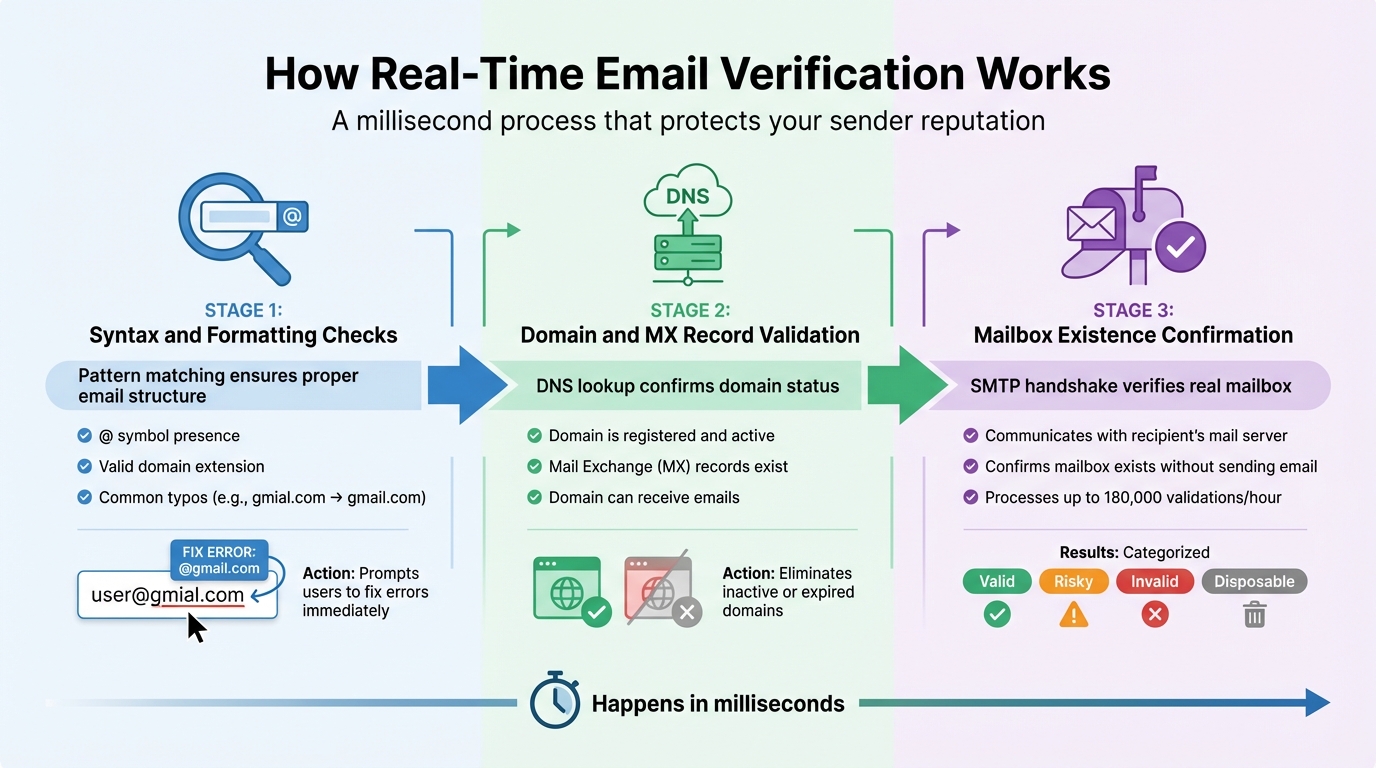
How Real-Time Email Verification Works in 3 Steps
Real-time email verification is a process that checks the validity of an email address the moment it’s entered. As explained, "Real-time email verification is a process that instantly checks the validity and accuracy of an email address as soon as it’s entered or submitted" [4]. This happens in milliseconds through an API that runs a series of checks before deciding whether the email address should be accepted or rejected. This layered process ensures that only reliable email addresses make it into your system.
The verification process unfolds in three key stages, each designed to catch and address specific issues that could harm your email deliverability.
Syntax and Formatting Checks
The first stage focuses on catching errors in the email’s structure. Using pattern matching, the system ensures the email follows standard formatting rules, such as containing the "@" symbol and a valid domain extension. It also flags common typos – like "[email protected]" instead of "[email protected]." When integrated into sign-up forms, these tools can prompt users to fix errors immediately, preventing bad data from entering your database.
Domain and MX Record Validation
Once the email passes the formatting check, the system digs deeper by performing a DNS lookup. This step confirms the domain is both registered and active. Additionally, it verifies the presence of Mail Exchange (MX) records, which are essential for receiving emails. Without valid MX records, even a properly formatted email address is essentially useless. This step eliminates addresses tied to inactive domains, expired companies, or domains not set up to handle emails.
Mailbox Existence Confirmation
The final and most advanced step involves confirming the existence of the recipient’s mailbox. This is done through an SMTP handshake, where the system communicates directly with the recipient’s mail server to check if the mailbox is real – without actually sending an email. Based on the response, the system categorizes the email as Valid, Risky, Invalid, or Disposable [11][12]. High-performance systems can process up to 180,000 email validations per hour using this method [11].
Benefits of Real-Time Email Verification
Real-time email verification isn’t just about keeping your email list clean – it’s about safeguarding your sender reputation, improving engagement, and cutting unnecessary costs. These practical benefits directly translate into measurable value for your business.
Lower Bounce Rates and Reduced Spam Risk
Every bounced email chips away at your sender reputation. Internet Service Providers (ISPs) like Gmail and Outlook view high bounce rates as a warning sign. If your bounce rate climbs above 2%, ISPs may start flagging your emails as spam or block them entirely [12]. Real-time email verification tackles this problem by preventing invalid addresses from ever entering your database.
Consider this example: A company facing a 12% bounce rate had their email service canceled. After implementing a real-time verification system, they slashed their bounce rate to nearly 0% [6].
Lower bounce rates also improve inbox placement. Businesses that use verification tools often see their inbox placement rates soar from 70% to over 90% [14]. As Customer.io points out:
"Poor deliverability and open rates will hurt your domain reputation. To an inbox provider, lots of bounces are a red flag for bad actors" [13].
Better Open Rates and Engagement
Beyond reducing bounces, email verification enhances engagement by ensuring your messages reach active, interested recipients. By removing invalid addresses, fake signups, and inactive accounts, you can focus on an audience that genuinely wants to hear from you. Verified lists often lead to open rates increasing by 10–25% and click-through rates improving by 15–30% [14]. In some cases, conversion rates climb by 20% or more [14].
Here’s why this matters: If more than 10% of your email list consists of bad addresses, deliverability for the rest of your emails can plummet below 44% [15]. Real-time verification eliminates this issue, ensuring your content lands in the inboxes of people who are ready to engage.
Savings and Smarter Metrics
Most Email Service Providers charge based on your subscriber count or the number of emails you send. That means invalid addresses inflate your costs while also skewing your analytics. With email data decaying at a rate of about 2% monthly – or over 22% annually [10] – you could be paying to send emails to accounts that no longer exist.
Verification doesn’t just save money on subscription fees – it also reduces hard bounce rates from 25% to under 2% [14]. This helps protect your sender reputation and avoids the costly process of recovering from blacklisting. As James Milsom, Head of Marketing at Hunter, puts it:
"Email verification is one of the cheapest, highest-leverage ways to protect revenue – ignoring it is far more expensive" [7].
Accurate verification also leads to more reliable analytics. When your data reflects genuine engagement rather than fake or bounced emails, you can make smarter decisions about your content, timing, and segmentation – turning guesswork into actionable insights.
sbb-itb-eece389
Using MailMonitor‘s Real-Time Email Verification

MailMonitor delivers email verification with an impressive 99% accuracy rate, along with a suite of tools designed to safeguard your sender reputation. By leveraging a global network of over 400 real mailboxes, the platform tests deliverability across more than 90 ISPs, offering actionable insights to improve your email campaigns[3].
API Integration
MailMonitor’s API allows for real-time email address validation, seamlessly integrating with sign-up forms and list imports to block invalid addresses on the spot. This feature ensures clean lists and smooth workflows for your sales and marketing teams, providing direct access to deliverability data and insights[3].
In 2024, Fusion HCS tapped into MailMonitor’s analytics and API to overhaul their email strategies. By transitioning to more effective sending practices, they achieved a 90% boost in inbox placement across a contact list of 1 million. CEO Dan Westenskow highlighted the impact:
"MailMonitor’s analytics gave us insight into which internal tools and practices were getting the best results. This allowed us to transition our entire salesforce from ineffective tools to more effective sending strategies."[3]
While real-time validation keeps your lists clean, MailMonitor’s additional features take deliverability optimization to the next level.
Additional Deliverability Tools
MailMonitor doesn’t stop at verification. Its 24/7 reputation monitoring tracks blocklisting, spam trap exposure, and authentication alignment with DMARC, SPF, and DKIM protocols. It also integrates data from Microsoft SNDS and Google Postmaster to offer a complete picture of your sender health[3].
With inbox placement testing, you can see exactly where your emails land – whether in the Primary inbox, Promotions tab, or spam folder – across various ISPs. This insight helps identify and address potential issues before launching large campaigns. Plus, MailMonitor alerts you to ISP throttling, which can slow down delivery rates[3][17].
In 2024, hubXchange used MailMonitor’s remediation tools to resolve spam-related challenges, recovering $271,000 in lost revenue from undelivered emails. Nathan Merryfield, Director of Marketing at hubXchange, shared:
"MailMonitor’s software is easy enough to understand for a beginner with little knowledge of email placement. But what sets them apart is their hands-on support to maximize our deliverability."[16]
Plans for Different Business Sizes
MailMonitor offers flexible plans tailored to businesses of all sizes, from startups to large enterprises. Its three tiers – Basic, Professional, and Enterprise – are designed to scale alongside your needs[17].
- Basic Plan: Includes inbox placement testing, reputation monitoring, and email verification.
- Professional Plan: Adds DMARC authentication, ISP monitoring, and custom alerts.
- Enterprise Plan: Offers unlimited seed tests, managed services, and advanced support for complex deliverability challenges.
For startups, MailMonitor provides an Inbox Audit for a one-time fee of $475. This service reviews placement, reputation, authentication, and blocklisting issues and includes a 30-minute consultation. For more intensive support, the Inbox Assured managed service costs $2,175 per month for three months. It includes 24/7 monitoring, on-demand placement testing, and biweekly review calls, with a guarantee of 90% inbox placement within 90 days for managed service users[16][17].
With these tools and services, MailMonitor equips you to measure and enhance the impact of email verification on your overall deliverability performance.
Measuring Email Deliverability After Verification
After implementing real-time email verification, it’s crucial to measure its impact. The goal goes beyond minimizing bounces; it’s about strengthening your sender reputation and increasing the likelihood of your emails landing in the primary inbox.
Key Metrics to Track
Bounce Rate: Hard bounces – when an email address doesn’t exist – are the clearest sign of verification success. A noticeable drop in hard bounces indicates that your verification efforts are working [18][19]. On the other hand, soft bounces, caused by temporary issues like full inboxes, usually remain unaffected since verification focuses on invalid addresses.
Inbox Placement Rate: This metric tells you where your emails actually land. Unlike delivery rate, which only confirms that emails didn’t bounce, inbox placement rate reveals whether your messages reach the primary inbox or end up in spam or promotional folders [18][19]. This data provides a clear view of how verification affects email placement [3].
Sender Score: Your sender score, ranging from 0 to 100, reflects your reputation with internet service providers (ISPs). A higher score increases the chances that mailbox providers will accept your emails [19][2]. Regularly monitoring this score helps you address any potential issues quickly.
Engagement Metrics: Metrics like open rates, click-through rates, and click-to-open rates often improve after verification because your emails are now reaching valid and engaged recipients. Additionally, tracking spam complaint rates and "deleted before reading" rates can help identify areas where your content or subject lines might need adjustments [18][19].
To fully understand the impact, compare these metrics before and after implementing email verification.
Before and After Comparisons
By comparing these metrics, you can see measurable improvements in deliverability and sender reputation. Start by establishing a baseline and monitor changes over a 30-day period. Many businesses report immediate reductions in bounce rates, followed by gradual increases in engagement as their sender reputation improves.
| Metric | Before Verification | After Verification | Improvement (%) |
|---|---|---|---|
| Bounce Rate | 12% | 2% | 83% |
| Inbox Placement | 80% | 95% | 18.75% |
| Open Rate | 20% | 30% | 50% |
These comparisons can help you fine-tune your email strategy and maintain strong deliverability rates. If your metrics don’t improve as expected, the problem might go beyond your email list quality. In such cases, review your SPF, DKIM, and DMARC configurations, and check for issues like blocklisting or spam traps [3][1]. Tools like MailMonitor’s 24/7 reputation monitoring can also help by providing detailed insights into technical factors and deliverability performance [3].
Conclusion
Real-time email verification is a game-changer when it comes to protecting your sender reputation and boosting ROI. By ensuring that only valid email addresses make it into your database, you can sidestep deliverability issues before they become major problems. Businesses that maintain bounce rates at or below 2% consistently achieve better inbox placement and higher engagement rates [9].
"A clean email list isn’t just a best practice – it’s your insurance policy against deliverability disasters." – EmailListChecker.io [21]
The financial rewards are hard to ignore. For example, Spotify slashed its bounce rate from 12.3% to 2.1% in just 60 days, leading to a 34% improvement in deliverability and an impressive $2.3 million boost in revenue [20]. Similarly, The Workplace Depot lowered their bounce rate from 4.6% to 0.4%, while also reducing spam complaints to a mere 0.23% [20]. These success stories highlight the real, measurable benefits of a well-maintained email list.
Beyond improving deliverability, real-time verification helps you make the most of your marketing budget by cutting down on wasted sends to invalid addresses and trimming platform fees tied to bloated contact lists.
Want to take control of your email deliverability? MailMonitor’s real-time email verification works seamlessly with tools like inbox placement testing, reputation monitoring, and deliverability management. Whether you’re a small business or a large enterprise managing millions of contacts, MailMonitor has scalable plans to fit your needs. Visit https://mailmonitor.com to explore our verification tools and start safeguarding your sender reputation today. Put real-time verification to work and take the first step toward email success.
FAQs
How does real-time email verification help improve your sender reputation?
Real-time email verification plays a crucial role in ensuring your email list stays clean and effective. It works by identifying and filtering out invalid, mistyped, or disposable email addresses before you hit send. This means your messages won’t be wasted on non-existent accounts or risky spam-trap addresses.
By avoiding these pitfalls, you can significantly reduce hard bounces and cut down on spam complaints. This, in turn, helps you maintain healthy bounce rates that align with the acceptable limits set by Internet Service Providers (ISPs). A low bounce rate protects and even strengthens your sender reputation, boosting the chances that your emails land in inboxes instead of getting flagged as spam.
What are the cost-saving benefits of using real-time email verification?
Real-time email verification is a smart way for businesses to cut unnecessary expenses tied to sending emails to invalid or inactive addresses. By reducing bounce rates, it safeguards your sender reputation and ensures more of your messages land in the right inboxes.
This approach doesn’t just save on wasted marketing dollars – it also boosts your return on investment (ROI) by improving the odds of meaningful customer interactions. Plus, it helps protect against revenue losses that can result from poor email deliverability.
How can businesses evaluate the effectiveness of their email verification process?
Businesses can measure the effectiveness of their email verification efforts by keeping an eye on crucial deliverability metrics. For starters, monitor your bounce rate – ideally, it should stay below 2%. Also, keep your spam complaint rate under 0.1%. Pay attention to improvements in inbox placement rates and a decline in invalid or inactive email addresses. These metrics are strong indicators of a healthier sender reputation and better audience engagement.
Regularly reviewing these numbers helps ensure your emails land where they’re supposed to – your audience’s inboxes. It also minimizes the risk of ending up in spam folders, supporting a strong and reliable email marketing strategy.

