
Sending emails? Avoid these common CAN-SPAM violations to stay compliant and maintain your sender reputation.
The CAN-SPAM Act sets rules for commercial emails in the U.S., requiring transparency and giving recipients the right to opt out. Violations can lead to hefty fines (up to $53,088 per email) and damage your email deliverability. Here’s what to avoid:
- Misleading Subject Lines: Be honest – don’t use tricks like “Re:” or “Urgent” unless accurate.
- Missing Opt-Out Options: Every email needs a clear, working unsubscribe link. Process opt-outs within 10 business days.
- False Sender Information: Use accurate “From” and “Reply-To” details. No spoofing or fake names.
- No Physical Address: Include a valid mailing address in every email.
- Emailing Without Permission: While prior consent isn’t required, sending unsolicited emails can hurt your reputation.
- Not Labeling Ads: Clearly mark promotional content to set expectations.
- Ignoring Unsubscribe Requests: Failing to honor opt-outs can lead to legal trouble and spam complaints.
Key takeaway: Transparency and respect for your audience are non-negotiable. Simple compliance measures protect your business and build trust.
Complying with the CAN SPAM Act – Business Tips | Federal Trade Commission
1. Misleading Subject Lines
Getting your subject line right is more than just a marketing tactic – it’s a key part of staying compliant and maintaining strong email performance. A good subject line should accurately represent the email’s content. Tricks like bait-and-switch tactics? Those can land you in hot water.
Compliance with CAN-SPAM Act Requirements
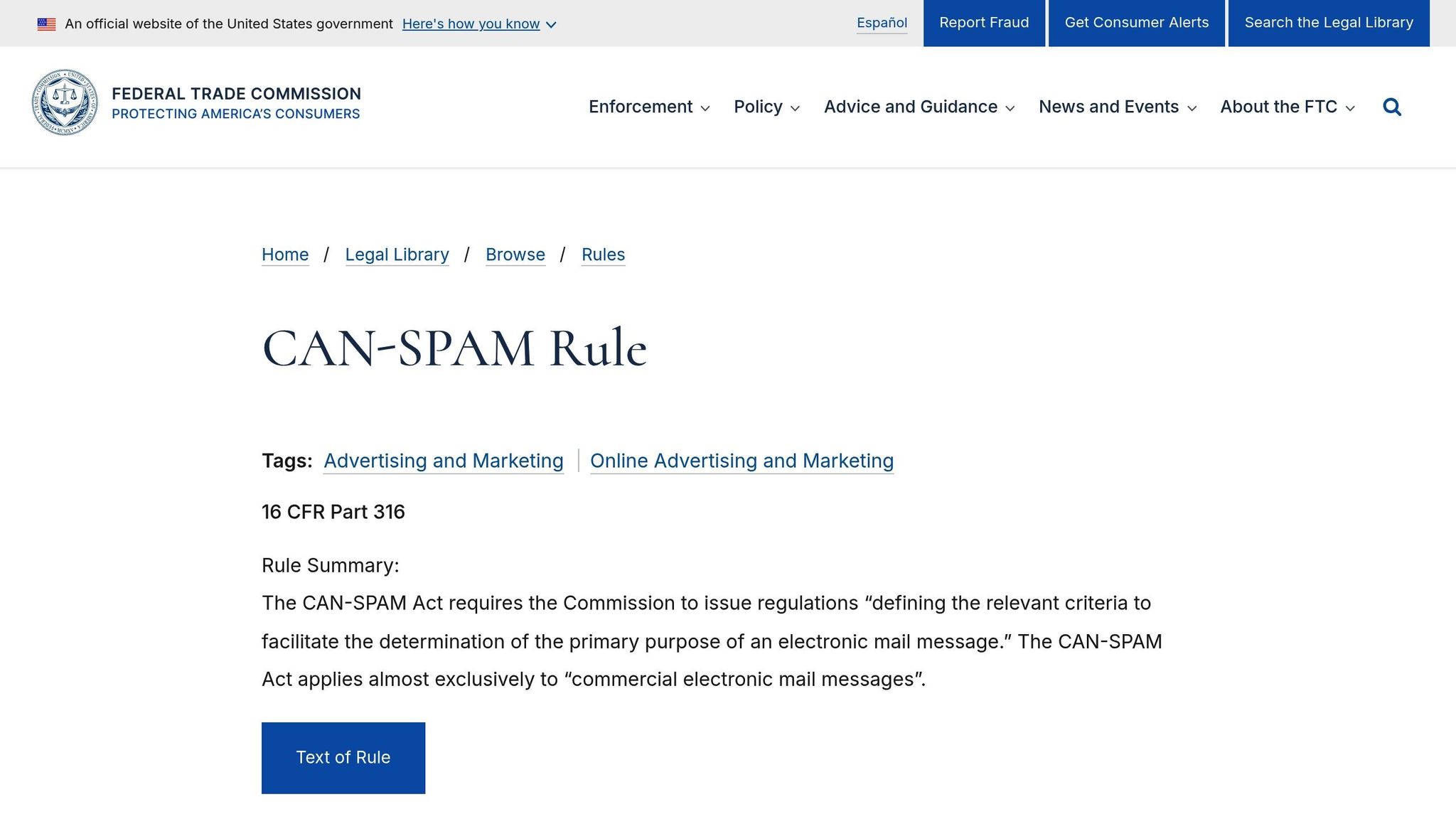
Your subject lines don’t have to be boring, but they do need to be honest. They should give recipients a clear sense of what they’ll find when they open the email. Misleading subject lines – like using "Re:" or "Fwd:" when the email isn’t actually a reply or forward – are a big no-no.
The FTC evaluates subject lines based on how a reasonable person would interpret them. If the subject line creates false expectations, it’s likely breaking the rules. For example, using phrases like "Urgent" for non-critical emails, advertising "free" items that have hidden costs, or implying the email contains vital account details when it’s just a promotion can all lead to trouble.
Impact on Email Deliverability and Sender Reputation
Using misleading subject lines doesn’t just risk legal consequences – it can also damage your email performance. When recipients feel tricked, they’re more likely to mark your emails as spam. This feedback sends a clear signal to email providers like Gmail and Yahoo that your messages aren’t welcome.
Once flagged, your emails could start landing in spam folders across the board, even for people who actually want to hear from you. While clickbait subject lines might temporarily boost open rates, the long-term damage to your reputation and engagement isn’t worth it. Internet service providers (ISPs) keep a close eye on metrics like open rates, clicks, and how long recipients spend reading your emails to decide if your messages deserve to hit the inbox.
Legal and Financial Consequences of Non-Compliance
Violating the CAN-SPAM Act by using deceptive subject lines can result in hefty fines for each offending email. Beyond that, the damage to your brand’s reputation can be even harder to fix. Negative publicity and lost customer trust can take months – or even years – to recover from, leaving your email marketing efforts struggling in the meantime.
The takeaway? Honest subject lines are the foundation of trust and better engagement. Up next, we’ll dive into another critical compliance requirement.
2. Missing Opt-Out Options
Every commercial email is legally required to include a clear and simple way for recipients to unsubscribe. This is a key mandate of the CAN-SPAM Act, ensuring that people can opt out of future emails without jumping through hoops – or paying unnecessary fees.
Compliance with CAN-SPAM Act Requirements
To stay compliant, make sure there’s a visible and easy-to-read unsubscribe link at the bottom of your emails. The process should be simple – ideally, a single click that only asks for the user’s email address. No one wants to fill out a form or remember a password just to stop receiving emails.
Once someone opts out, you’re obligated to process their request within 10 business days. After that, you must stop sending them promotional emails. Charging fees or adding unnecessary steps violates the law.
It’s also important to avoid common mistakes like using tiny fonts for the unsubscribe link, hiding it in the email, or including links that don’t work.
Impact on Email Deliverability and Sender Reputation
If unsubscribing feels like a hassle, frustrated recipients might flag your emails as spam. This can drag down your sender reputation and hurt your email deliverability rates. Plus, a clunky opt-out process can sour the user experience, leading to lower engagement – fewer opens, clicks, and interactions.
Legal and Financial Consequences of Non-Compliance
Ignoring these rules can land you in serious trouble. The FTC enforces these regulations, and violations can result in hefty fines, legal investigations, or lawsuits. Beyond the legal risks, news of violations spreads fast, especially on social media and forums. This kind of publicity can damage your brand’s reputation and lead to long-term trust issues with your audience.
Up next, we’ll explore how misleading sender information can create even more compliance risks.
3. False Sender Information
Using fake or misleading sender details – like spoofed email addresses or deceptive display names – is a serious breach of the CAN-SPAM Act.
Compliance with CAN-SPAM Act Requirements
The CAN-SPAM Act requires that email header information clearly and truthfully represents the sender. This means the "From", "To", and "Reply-To" fields must accurately reflect the actual sender, even if you’re sending on behalf of a client. Also, ensure you use a valid, monitored reply-to address so recipients can reach you if needed.
To protect your sender identity, it’s smart to implement domain authentication protocols like SPF, DKIM, and DMARC. These protocols verify that you’re authorized to send emails from your domain, reducing the chances of your messages being flagged as suspicious. Not only does this help you comply with legal standards, but it also builds trust with internet service providers (ISPs) and your audience. Accurate sender information is key to maintaining both compliance and strong email deliverability.
Impact on Email Deliverability and Sender Reputation
Using misleading sender details can seriously damage your email deliverability. ISPs and email clients use advanced filters that flag inconsistencies in sender information. When flagged, your emails are more likely to end up in spam folders – or get blocked entirely.
Beyond technical issues, a poor sender reputation can hurt your engagement rates. Recipients who spot misleading details are more likely to mark your emails as spam or unsubscribe. This creates a downward spiral: fewer engaged users lead to even worse deliverability over time.
Legal and Financial Consequences of Non-Compliance
The Federal Trade Commission (FTC) enforces the CAN-SPAM Act, and violations can result in hefty fines. If misleading sender information is linked to fraudulent activity, additional legal penalties may apply.
On top of that, email service providers often suspend or terminate accounts that repeatedly use deceptive sender details. This can bring your email campaigns to a grinding halt. Rebuilding your sender reputation and regaining access to suspended accounts is no small task – it’s a time-consuming and challenging process that can set your marketing efforts back significantly.
4. No Physical Address Listed
Including a valid physical mailing address in every commercial email is more than just a good practice – it’s a legal requirement under the CAN-SPAM Act. This rule not only keeps you compliant but also helps build trust with both email providers and your audience.
Compliance with CAN-SPAM Act Requirements
The CAN-SPAM Act mandates that all commercial emails must feature a valid and complete mailing address. This address can be your business headquarters, a registered office, a P.O. Box, or even a Virtual Business Address if you work remotely. The key is to ensure the address is legitimate because email providers are quick to flag invalid ones. Skipping this step not only risks violating the law but also damages your email’s credibility.
Just like clear subject lines and easy opt-out options, a valid physical address is a non-negotiable for maintaining both legal compliance and good deliverability rates.
Impact on Email Deliverability and Sender Reputation
Failing to include a physical address can send the wrong signal to email providers, making your messages appear suspicious. Flodesk explains it well:
"When you don’t include a physical mailing address in your emails, this can be a red flag to your subscribers’ email provider that your email may not be trustworthy. This can cause your emails to be blocked, which results in bounced emails and spam complaints." [1]
Email giants like Gmail, Yahoo, and Outlook actively check for compliance indicators. Without a mailing address, your emails are far more likely to end up in spam folders. AWeber adds:
"If no address is found, the email may just be sent to peoples’ spam folders. Because… if there’s no address, it looks like spam." [2]
Including a proper physical address not only keeps you compliant but also reassures subscribers that you’re a legitimate sender. It’s a small detail that can make a big difference in how your emails are received.
sbb-itb-eece389
5. Emailing Without Permission
The CAN-SPAM Act has a unique approach to email permissions that often catches marketers off guard. Unlike many other regions where explicit consent is required before sending commercial emails, the U.S. focuses more on what happens after the email is sent rather than requiring permission upfront.
Compliance with CAN-SPAM Act Requirements
Here’s the key takeaway: the CAN-SPAM Act does not mandate prior consent before sending commercial emails in the U.S. However, every email must include an opt-out mechanism, and unsubscribe requests must be honored within 10 business days.
It’s important to note that this law applies to all commercial emails, including business-to-business communications. There are no exceptions – every email must follow the same rules.
Impact on Email Deliverability and Sender Reputation
While you’re legally allowed to send emails without prior consent, doing so comes with risks. Sending unsolicited emails can harm your sender reputation, even if you’re technically compliant with CAN-SPAM.
Email providers like Gmail, Yahoo, and Outlook don’t just look for legal compliance – they monitor engagement metrics like open rates, spam complaints, and unsubscribes. When you email people who didn’t opt in, you’re more likely to see higher complaint rates and lower engagement. Over time, this can push your emails straight into spam folders, making it harder to reach any audience.
Best practice tip: Even though it’s not legally required, getting explicit consent before sending commercial emails is the smarter move. It shows respect for your audience and typically leads to better engagement rates and improved deliverability.
If you do send cold emails, make them personal and transparent. Avoid generic, mass emails to unpermissioned lists – they’re more likely to be flagged as spam. Instead, craft messages that explain why you’re reaching out and how it’s relevant to the recipient. This approach not only helps with compliance but also boosts campaign performance.
Legal and Financial Consequences of Non-Compliance
The CAN-SPAM Act explicitly prohibits deceptive practices like hacking into someone’s computer to send spam, using fake information to create email accounts, or harvesting email addresses without consent. Violating these rules can lead to hefty fines.
Each email that breaks the law can result in fines of up to $53,088 [3]. For example, a single campaign sent to 1,000 recipients could theoretically lead to over $53 million in penalties if every email violates the Act.
The Federal Trade Commission (FTC) actively enforces these rules, particularly targeting businesses that engage in misleading practices or fail to provide proper opt-out options. Staying compliant not only helps you avoid fines but also supports long-term email deliverability – which is crucial for any email marketing strategy.
To maintain compliance and protect your sender reputation, tools like MailMonitor can be invaluable. They help track your email deliverability and provide insights into how your campaigns perform across different email platforms, ensuring your messages land in inboxes – even when reaching out to broader audiences.
6. Not Labeling Promotional Content
It’s crucial to clearly label advertisements and promotional material in your emails. This isn’t just about being upfront with your audience – it’s also about staying compliant with federal regulations designed to protect consumers from misleading marketing practices.
Compliance with CAN-SPAM Act Requirements
The CAN-SPAM Act doesn’t prescribe a specific way to label promotional content, but it does require that promotional emails are clearly identified as such. You have some flexibility in how you approach this, but the key is clarity. Using labels like "Advertisement" or "Promotional" can make the purpose of your email immediately obvious. This clarity not only meets legal expectations but also helps build trust with your audience.
Impact on Email Deliverability and Sender Reputation
Being transparent about promotional content does more than keep you compliant – it can improve your email deliverability and sender reputation. When recipients understand the purpose of your email from the start, they’re less likely to mark it as spam or file complaints. Email providers monitor engagement metrics like these to decide whether your messages land in inboxes or spam folders. Clear labeling helps set the right expectations, which can lead to better engagement and a stronger sender reputation.
To fine-tune your approach, tools like MailMonitor can track how your emails perform across different providers. Experimenting with labeling methods and monitoring their impact on deliverability can help you find what works best for your audience.
Legal and Financial Consequences of Non-Compliance
Failing to label promotional content can lead to serious consequences. Non-compliance with federal regulations could result in hefty fines and increased scrutiny of your email marketing practices.
To avoid these risks, make clear labeling a standard part of your email process. Create templates that automatically include labels for promotional content and train your team to identify when these labels are needed. This proactive approach not only reduces legal risks but also supports better email performance.
It’s worth noting that state laws may impose additional requirements beyond the CAN-SPAM Act. If you’re unsure about compliance in specific areas, consulting with legal counsel can provide valuable guidance.
7. Not Processing Unsubscribe Requests
Failing to handle unsubscribe requests quickly is one of the biggest missteps you can make in email marketing. Ignoring these requests – or even delaying them – can seriously damage your sender reputation and potentially land you in legal trouble. When someone decides to opt out of your emails, the process should be simple, immediate, and compliant with legal requirements. Plus, it’s just good business sense.
Compliance with CAN-SPAM Act Requirements
The CAN-SPAM Act has clear rules about how to manage unsubscribe requests. You have exactly 10 business days to process opt-outs after receiving them – no exceptions. The law also requires that the unsubscribe process be straightforward, like clicking a single link or sending one reply email. Anything more complicated than that is a violation.
Here’s what you can’t do:
- Charge fees for unsubscribing.
- Ask for extra personal details beyond the email address.
- Force users through multiple steps to opt out.
Once someone unsubscribes, their email can’t be sold, transferred, or shared for marketing purposes. To avoid mistakes, use automated systems to handle unsubscribes and ensure those addresses are added to suppression lists. This way, you won’t accidentally re-add them during data updates.
Impact on Email Deliverability and Sender Reputation
If you delay processing unsubscribe requests, you’re inviting trouble. Frustrated recipients are more likely to mark your emails as spam. When this happens, your sender reputation takes a hit, and email providers start flagging your messages.
Here’s the reality: email providers closely monitor complaint rates. If your complaint rate goes above 0.3%, many providers will automatically start routing your emails to spam folders. Worse, repeated complaints can get your sending domain or IP address blacklisted, effectively shutting down your email campaigns.
To stay ahead, use tools like MailMonitor to keep an eye on complaint rates and ensure your unsubscribe process is running smoothly. Regular monitoring can help you catch issues early, before they snowball into major deliverability problems. Ignoring this step not only hurts your email performance but also increases the risk of legal and financial consequences.
Legal and Financial Consequences of Non-Compliance
The penalties for failing to honor unsubscribe requests can be steep. Under the CAN-SPAM Act, fines can reach up to $51,744 per violation. And here’s the kicker: every email sent after someone unsubscribes counts as a separate violation, which can cause penalties to pile up fast.
On top of federal fines, email service providers (ESPs) often take action against accounts with high complaint rates or poor unsubscribe practices. If your ESP suspends or terminates your account, you could face thousands of dollars in lost revenue – not to mention the time and effort needed to rebuild your email program from scratch.
State laws can make things even more complicated. For example, California’s privacy laws impose additional rules for handling opt-outs and consumer data, with their own fines and penalties for non-compliance.
The best way to avoid these headaches is to make unsubscribe processing a core part of your email strategy. Automate the process wherever possible, and set up clear workflows for any manual tasks. Regularly audit your system to identify any weak spots or delays. By honoring unsubscribe requests promptly, you not only stay compliant but also strengthen your email reputation and maintain trust with your audience.
Tools for CAN-SPAM Compliance
Staying on top of CAN-SPAM compliance requires more than just good intentions – it demands constant vigilance and the right tools to avoid costly mistakes. Relying on manual processes can lead to oversights, but automated tools make compliance easier and protect your sender reputation.
These tools can monitor your sender reputation, track complaint rates, and identify potential issues that could trigger spam filters or legal trouble. For example, if your complaint rates spike, automated alerts ensure you’re notified immediately, rather than finding out after your emails have already landed in spam folders.
Inbox placement testing is another essential feature, showing exactly where your emails end up – whether in the inbox, spam folder, or even the promotions tab. If your emails consistently hit the spam folder, it’s a clear sign that something in your setup or content needs attention to avoid compliance risks.
MailMonitor is one such platform offering a suite of tools, including reputation monitoring, inbox placement testing, and email verification, to help ensure your messages land where they’re supposed to. Their managed services go a step further, providing ongoing consultation, blocklist removal, and proactive monitoring. Custom alerts can flag spikes in complaint rates, delivery issues, or authentication failures, giving you the chance to act before problems escalate.
Effective compliance tools also simplify crucial tasks like unsubscribe management. For example, authentication monitoring ensures your DMARC, SPF, and DKIM records are in order. If these protocols fail, email providers may treat your messages as suspicious, leading to deliverability problems. Automated systems also handle suppression lists, ensuring opted-out addresses are added and unsubscribe requests are processed within the required 10 business days.
For businesses sending high volumes of email, managed services provide an extra layer of oversight. These services can include expert consultations, proactive monitoring, and blocklist removal to address issues early, especially when dealing with complex infrastructures or multiple sending domains.
Modern monitoring tools don’t just track basic metrics – they provide early warnings of potential compliance problems. Custom alerts let you respond quickly, reducing the risk of significant violations. The best platforms also offer actionable recommendations, guiding you through steps like adjusting your sending frequency, updating authentication records, or improving your opt-in process.
Ultimately, the right tools do more than just identify problems – they help you fix them. By offering insights and practical solutions, these platforms can improve both compliance and overall email performance.
Conclusion
Following CAN-SPAM guidelines isn’t just about avoiding fines – it’s about safeguarding your brand’s reputation and earning the trust of your audience. Ignoring these rules can lead to more than just financial penalties; it can damage your sender reputation and erode customer confidence.
Fortunately, staying compliant is manageable with consistent attention to detail. Many violations stem from avoidable mistakes, like leaving out your physical address, misleading subject lines, or failing to process unsubscribe requests promptly. These are simple errors that can be prevented with proper processes in place.
As we’ve covered, even small missteps – like a deceptive subject line or poorly handled unsubscribes – can harm your email deliverability. Internet Service Providers may start flagging your emails as spam, which can lead to higher complaint rates and long-term deliverability issues that are tough to fix.
The secret to lasting success is treating compliance as an ongoing effort, not a one-time task. Email regulations can change, and as your business grows, regular audits and tools like MailMonitor can help ensure your campaigns remain both compliant and effective.
Every email you send represents your brand. By adhering to CAN-SPAM rules, you’re not just avoiding legal trouble – you’re showing respect for your subscribers and laying the groundwork for strong, sustainable email marketing. Make these practices a core part of your strategy to stay compliant and keep your audience engaged.
FAQs
What are the best practices for ensuring your email campaigns comply with the CAN-SPAM Act?
To stay within the guidelines of the CAN-SPAM Act, make sure to follow these key practices: use truthful header details and subject lines, clearly indicate if the email is promotional, include a valid physical mailing address, and offer recipients a straightforward way to opt out. These actions not only keep you compliant but also help establish transparency and trust with your audience.
On top of that, it’s a good idea to periodically review your email marketing efforts to ensure they remain compliant. Being vigilant not only helps you sidestep potential fines but also boosts your email deliverability and reinforces your reputation as a sender.
What’s the best way to handle unsubscribe requests to protect your sender reputation?
To maintain a good sender reputation, it’s essential to address unsubscribe requests promptly and effectively. The CAN-SPAM Act mandates that businesses process opt-out requests within 10 business days, so ensure your system is equipped to meet this requirement.
Every email you send should have a clear and easily accessible unsubscribe option – like a one-click link at the bottom – so recipients can opt out without hassle. You might also want to offer a preference center where users can modify their email preferences instead of unsubscribing altogether. This approach can help minimize opt-outs while keeping your audience connected to the content they care about.
What are the risks of using misleading subject lines in email marketing, and how can you avoid them?
Using misleading subject lines in email marketing can backfire in several ways. It damages your reputation, lowers engagement rates, and can trigger spam complaints. Worse yet, it might land you in legal trouble. The CAN-SPAM Act enforces strict rules, and violations could result in hefty fines.
To steer clear of these issues, keep your subject lines honest and straightforward. Make sure they clearly reflect the content of your email. Avoid using deceptive wording or phrases that might trigger spam filters. This approach not only helps you stay compliant with regulations but also builds trust with your audience over time.

