
B2B and B2C email marketing have distinct strategies and performance metrics. While B2B emails target professionals with logical, solution-driven content, B2C emails appeal to consumers with emotional, urgency-based messaging. Here’s what you need to know:
- Open Rates: B2B averages 37.4%, while B2C sees 40%. However, B2B excels in engagement after opening.
- Click-Through Rates (CTR): B2B outperforms with 3.2% compared to B2C’s 2.1%.
- Click-to-Open Rates (CTOR): B2B leads with 13%, far exceeding B2C’s 5.5%.
- ROI: Both deliver strong returns, with B2B averaging $46 and B2C ranging from $45 to $72 per $1 spent.
- Challenges: Apple’s Mail Privacy Protection inflates open rates, making CTR and CTOR more reliable metrics.
Quick Comparison:
| Metric | B2B | B2C |
|---|---|---|
| Open Rate | 37.4% | 40.0% |
| Click-Through Rate | 3.2% | 2.1% |
| Click-to-Open Rate | 13.0% | 5.5% |
| ROI (per $1 spent) | $46 | $45–$72 |
B2B thrives on targeted, relationship-driven campaigns, while B2C emphasizes volume and emotional triggers. Both require strong deliverability practices, like email authentication and list hygiene, to succeed.
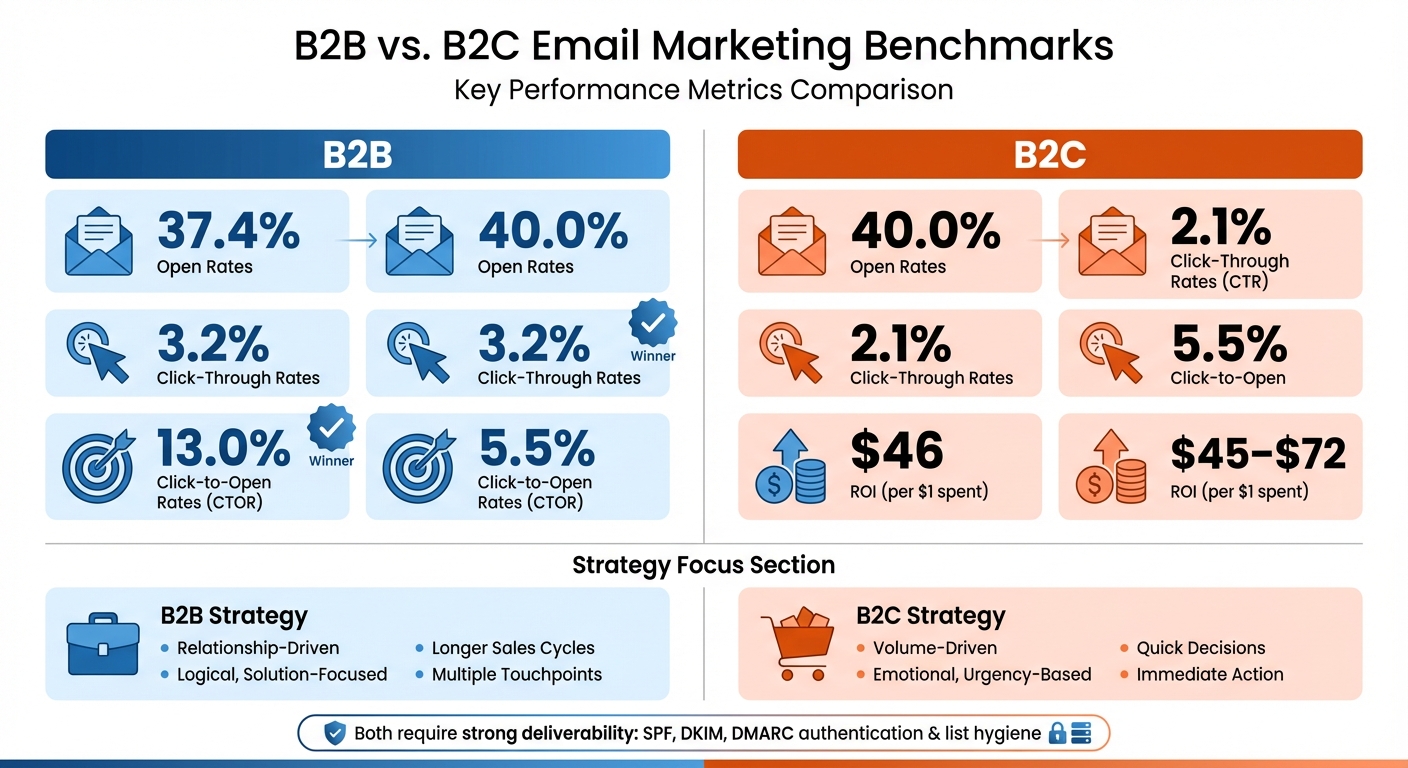
B2B vs B2C Email Marketing Benchmarks Comparison
B2B Email Marketing Benchmarks and How to Use Them–Chad S. White
Open Rates: B2B vs. B2C
When comparing email open rates, the numbers tell an interesting story. On average, B2B emails achieve a 39.48% open rate, slightly edging out B2C retail campaigns, which hover around 38.58% [1]. However, the type of email matters. Hyper-personalized B2B emails push the open rate to 41.9%, while newsletter-style B2B emails hit 41.3% [7]. On the other hand, eCommerce B2C campaigns face challenges with an open rate of 35.66% [3], largely because of the overwhelming number of promotional emails consumers receive daily.
So, what drives this difference? It boils down to audience behavior. B2B recipients, who often deal with over 100 emails per day [4], are drawn to content that demonstrates authority, quality, and social proof. For example, emails sent from a named individual perform 27% better than those sent from generic aliases [7]. Including a company name or industry in the subject line can further boost open rates by 11% [7]. On the flip side, B2C audiences are more likely to respond to tactics like urgency or scarcity – phrases like "Only 3 left in stock" or "Flash sale ends tonight" often work well [1].
The subject line is a critical factor in email performance. A staggering 64% of recipients decide whether to open an email based solely on the subject line [8]. However, 69% may also mark an email as spam for the same reason [9]. For B2B emails, subject lines under 45 characters deliver an average open rate of 38% [7]. Using questions in subject lines can increase opens by up to 50% [1], and adding personalization tokens boosts open rates by an additional 9% [7].
Mobile optimization is another key consideration. With 61% of B2B emails being opened on mobile devices [7], subject lines must render correctly on smaller screens. Additionally, emails need to load in under 2 seconds, as delays can increase bounce rates by 12% [7]. Timing also plays a role: Tuesday at 10 a.m. is the sweet spot for B2B emails [7], while B2C campaigns often perform better on Sunday evenings [1].
One factor complicating open rate metrics is Apple’s Mail Privacy Protection, which has inflated open rates by about 18 percentage points since its introduction in 2021. This feature affects approximately 46% of email clients [1][6], making open rates less reliable as standalone metrics. As a result, marketers are shifting focus to click-through rates and click-to-open rates for a more accurate measure of engagement.
Click-Through Rates: B2B vs. B2C
When it comes to email marketing, B2B emails achieve a 3.2% CTR, compared to 2.1% for B2C [10]. Even though B2B emails tend to have fewer opens, they often result in higher engagement. Why? It boils down to intent and content quality.
B2B audiences typically open emails with a purpose. They’re seeking solutions to specific business challenges – whether that’s through whitepapers, case studies, or data-backed insights to guide their decisions [10][2]. On the other hand, B2C recipients are quicker to dismiss promotional emails unless there’s an immediate, compelling reason to click. For example, 69% of mobile users will delete an email if it’s not mobile-friendly [10].
The Power of CTA Design
Clear and focused CTAs (calls-to-action) are game-changers. Emails with a single, prominent CTA button can see 371% more clicks than those with multiple competing links. Personalization also makes a difference, with tailored CTAs boosting conversions by 202% [1]. In B2B emails, phrases like "Download the Report" or "Schedule a Demo" resonate well. For B2C, urgency-driven CTAs such as "Shop Now" or "Claim Your Discount" perform better [10][2].
CTA format matters too – large, colorful buttons outperform plain text links, especially on mobile devices, where 48% of emails are opened [10].
Industry Benchmarks
CTR performance varies widely across industries. In B2B, the legal sector leads with a 6.3% CTR, closely followed by education at 6.2% [11]. On the lower end, industries like advertising and marketing see a CTR of just 1.62%, while IT/tech/software averages around 1.86% [14]. For B2C, retail typically achieves a CTR of 2.04%, while nonprofits stand out with 3.46% [14]. These differences highlight the importance of aligning content with audience expectations.
The Role of Segmentation
Segmentation is a critical strategy for maximizing CTRs. In B2B, marketers who segment based on job title, industry, or specific pain points can drive stronger engagement by addressing the unique challenges of each decision-maker [13]. For B2C, segmentation often focuses on factors like purchase history, browsing habits, or triggers such as abandoned carts [10][12]. Whether you’re marketing enterprise solutions or consumer products, targeted messaging is key to driving clicks and boosting engagement.
Conversion Rates and ROI: B2B vs. B2C
Click-through rates might give you a glimpse, but conversion rates and ROI tell the real story of a campaign’s financial success. Even though the differences in conversion rates between B2B and B2C might seem minor, the strategies behind them are worlds apart.
For every $1 spent, B2B email marketing generates $46 in return [7]. Meanwhile, B2C campaigns can bring in between $45 and $72 per dollar invested [18][19]. Automated workflows play a huge role in boosting B2C ROI – take abandoned cart emails, for example, which recover about $3.07 per recipient [1].
The difference in ROI largely comes down to how buyers behave. B2C customers tend to make decisions quickly – sometimes within hours or days – often influenced by urgency, discounts, or emotional appeals [15]. On the other hand, B2B buyers face longer decision-making processes, involving multiple stakeholders and budget approvals [15]. This is why persistence pays off in B2B: sending more than eight marketing emails during the sales cycle can increase close rates by 47% [16]. In short, B2B success depends on consistent nurturing, while B2C thrives on quick, decisive actions.
Here’s a quick breakdown of the numbers:
| Metric | B2B | B2C |
|---|---|---|
| Average Conversion Rate | 2.4% [17] | 2.8% [17] |
| ROI (per $1 spent) | $46 [7] | $45–$72 [18][19] |
For B2B campaigns, focus on multi-step automation workflows, which deliver nearly 1.9x higher ROI compared to one-off emails [7]. In B2C, behavioral triggers are key: welcome emails can generate $2.35 per recipient, while browse abandonment emails average $0.95 per recipient [1]. Personalization also makes a huge impact – segmented campaigns can boost revenue by up to 760% [19].
sbb-itb-eece389
Deliverability and Engagement Metrics
Getting emails into inboxes and maintaining a solid sender reputation go hand in hand. While global email deliverability rates hover around 98% [5], about 14.3% of emails still land in spam folders [22]. The differences between B2B and B2C campaigns become clear when looking at how they balance list quality, engagement, and send volume.
B2B campaigns tend to focus on smaller, more targeted audiences, which helps keep their lists cleaner. For instance, industries like B2B Services and SaaS report average bounce rates of around 0.5%, whereas Retail campaigns experience slightly higher rates at 0.62% [1]. Spam complaint rates also differ: Financial Services see abuse rates of roughly 0.09%, while Retail and Advertising sectors report 0.18% and 0.17%, respectively [20]. This reflects how B2B marketers prioritize relationship-driven communication and rigorous list management, which ties directly to their overall success.
B2C campaigns, on the other hand, face unique hurdles. With higher send frequencies – usually 2–3 emails per week compared to 1–2 for B2B [5] – and broader consumer audiences, they risk overwhelming recipients. In fact, 44% of consumers will unsubscribe if they feel bombarded with emails [22], and 1 in 5 consumers receives more than 16 promotional emails daily [10][18]. This higher frequency can lead to email fatigue and increased unsubscribe rates, making it crucial for B2C marketers to adopt strong technical practices.
Protocols like SPF, DKIM, and DMARC are non-negotiable for ensuring email authentication. Following these standards can push deliverability rates up to 94.2% [3]. B2B senders, in particular, also face secure email gateways like Proofpoint and Mimecast, which demand stricter authentication measures [10].
As email marketing evolves, so do the performance metrics that matter. With features like Mail Privacy Protection changing the landscape, marketers need to focus more on CTOR and conversion rates [5][1]. Whether you’re managing B2B or B2C campaigns, keeping bounce rates below 2% and spam complaints under 0.1% remains essential for preserving your sender reputation [21][20].
How to Improve Your Email Benchmarks
Did you know that authenticated emails have a much better chance of landing in inboxes? Emails authenticated with protocols like SPF, DKIM, and DMARC achieve an impressive 83.75% inbox placement rate, compared to just 44.99% for unauthenticated ones – a 2.7x difference! Despite this, only 7.6% of domains globally enforce DMARC policies with quarantine or reject settings, leaving a lot of room for improvement [23].
But authentication alone won’t cut it if your email list is filled with invalid addresses. Hard bounces can seriously harm your sender reputation, so keeping bounce rates below 2% is critical [14]. Unfortunately, only 23.6% of B2B marketers verify their email lists before launching campaigns [23]. Regular email verification can help by removing disposable addresses and catching typos, reducing the risk of bounces and protecting your sender reputation. Beyond that, using inbox testing tools can give you even more control over your email performance.
For example, MailMonitor’s inbox placement testing can show exactly where your emails land – whether in the inbox, spam folder, or elsewhere – across major providers like Gmail, Microsoft, and Yahoo. This is especially crucial given that Microsoft’s inbox placement rate plummeted to just 26–50% in 2025, a sharp 26.7 percentage-point drop from the previous year [23]. With these insights, you can adjust your authentication settings, refine your content, or tweak your sending patterns to improve your deliverability metrics.
If you’re a high-volume sender, the stakes are even higher. Organizations sending over 1 million emails monthly saw an average inbox placement rate of just 27.63% in 2025 [23]. To mitigate this, consider using domain rotation or subdomain segmentation to spread out your email volume and avoid triggering penalties. Tools like Google Postmaster and Microsoft SNDS can also help you monitor your reputation by tracking complaint rates, which should stay below 0.1% to avoid blacklisting [23].
New domains bring their own challenges. Domains less than three months old typically see a 55% inbox placement rate, compared to around 85% for domains that have been active for over two years [23]. To combat this, it’s essential to warm up new IPs or domains gradually. For B2B campaigns, start small – sending about 50 emails per day – and scale up over 4–12 weeks [2][23]. While B2C campaigns can ramp up faster, a controlled warmup is still key to building trust with email providers and maintaining strong deliverability rates.
Conclusion
B2B and B2C email marketing operate on very different timelines and strategies, each tailored to match the unique decision-making processes of their audiences. B2B campaigns focus on logic and ROI, requiring educational content and multiple touchpoints to support longer buying cycles. On the other hand, B2C campaigns thrive on emotional appeal and urgency, using visually engaging content to drive quicker purchasing decisions. Unsurprisingly, B2B emails tend to achieve higher click-through rates (around 3.2% compared to B2C’s 2.1%), though B2C campaigns might sometimes achieve higher open rates in specific industries [15][10].
No matter the approach, deliverability is the cornerstone of success. If your emails don’t make it to the inbox, even the best-crafted content won’t make an impact. Authentication plays a critical role here, especially for B2B campaigns, where secure email gateways like Proofpoint and Mimecast add additional hurdles [10].
To tackle these challenges, advanced tools come into play. For example, MailMonitor offers essential features like inbox placement testing to determine whether your emails end up in the primary inbox, spam, or promotions. It also provides reputation monitoring and email verification tools to maintain clean lists, reduce hard bounces, and safeguard your sender reputation before issues arise.
Whether you’re nurturing long-term relationships in B2B or driving quick decisions in B2C, the focus should remain on authentication, list hygiene, and consistent deliverability testing. With tools like MailMonitor, you can ensure your emails reach the right inbox, enabling smarter, data-driven campaigns tailored to your audience.
FAQs
How does Apple’s Mail Privacy Protection impact email marketing metrics?
Apple’s Mail Privacy Protection changes the game for tracking email open rates. This feature automatically pre-loads email content, which means emails can be marked as "opened" even if the recipient hasn’t actually clicked on or viewed them. The result? Open rates might look higher than they truly are, making them a less reliable measure of user engagement.
To adjust, marketers should shift their focus to metrics that provide a clearer picture of campaign performance. Key indicators like click-through rates, conversion rates, and overall engagement trends offer a more accurate way to gauge how well your emails are resonating with your audience.
What are the main differences between B2B and B2C email marketing strategies?
When it comes to email marketing, the strategies for B2B (business-to-business) and B2C (business-to-consumer) campaigns differ in key areas like audience focus, content style, and goals.
B2B email marketing focuses on building professional relationships by delivering content that’s informative and supports decision-making. These emails are tailored to help businesses solve problems or make informed choices, making them a tool for fostering long-term partnerships. With an average open rate of 31.35%, B2B campaigns often rely on precise segmentation and personalization to connect with their audience.
B2C email marketing, on the other hand, is all about capturing attention quickly and driving immediate actions, such as purchases or sign-ups. These emails are visually engaging and often use emotional appeals or promotional offers to spark interest. With an average open rate of 35.63%, B2C campaigns focus on short-term results and frequently use automation to customize messages based on individual preferences.
Both strategies succeed when they prioritize deliverability, understand audience behavior, and align their content with industry standards to achieve the best results.
What are the best ways to improve email deliverability for my campaigns?
Start by cleaning your email lists regularly. Removing invalid or inactive addresses not only lowers bounce rates but also protects your sender reputation. A clean list is a key step toward ensuring your emails actually land in inboxes.
Next, implement email authentication protocols like SPF, DKIM, and DMARC. These help email providers verify that your messages are legitimate, reducing the chances of them being flagged as spam.
Want better open rates? Focus on crafting engaging and personalized content. Avoid spammy trigger words that might send your emails straight to the junk folder. If you’re using a dedicated IP address, remember to warm it up gradually. Start with smaller email batches and increase volume over time to establish trust with email providers.
Tools like MailMonitor can be a game-changer. They allow you to track your sender reputation, test inbox placement, and ensure your messages are hitting the right spot. Finally, keep a close eye on your deliverability metrics. Addressing any issues quickly will help maintain the performance of your email campaigns.

