

When it comes to email marketing, getting your emails into the inbox – not the spam folder or promotions tab – is critical. While 98% of emails are technically delivered, only 34% on average make it to inboxes globally. This gap, caused by factors like ISP filters, anti-spam laws, and user engagement, represents lost opportunities for businesses.
Key findings:
- North America leads with an 87.9% inbox placement rate, while Asia-Pacific lags at 78.2%.
- 50.9% of senders misunderstand delivery metrics, equating delivery with inbox placement.
- Only 13% of senders test inbox placement, leaving many campaigns blind to performance issues.
- Compliance with regional laws (e.g., GDPR, CAN-SPAM) and strong authentication (SPF, DKIM, DMARC) are must-haves.
- Poor engagement – like high spam complaints or low opens – can harm your sender reputation.
If you’re sending emails globally, understanding these factors is essential to improving visibility, clicks, and revenue. Below, we break down the five key reasons email placement varies by region and how you can improve your email strategy.
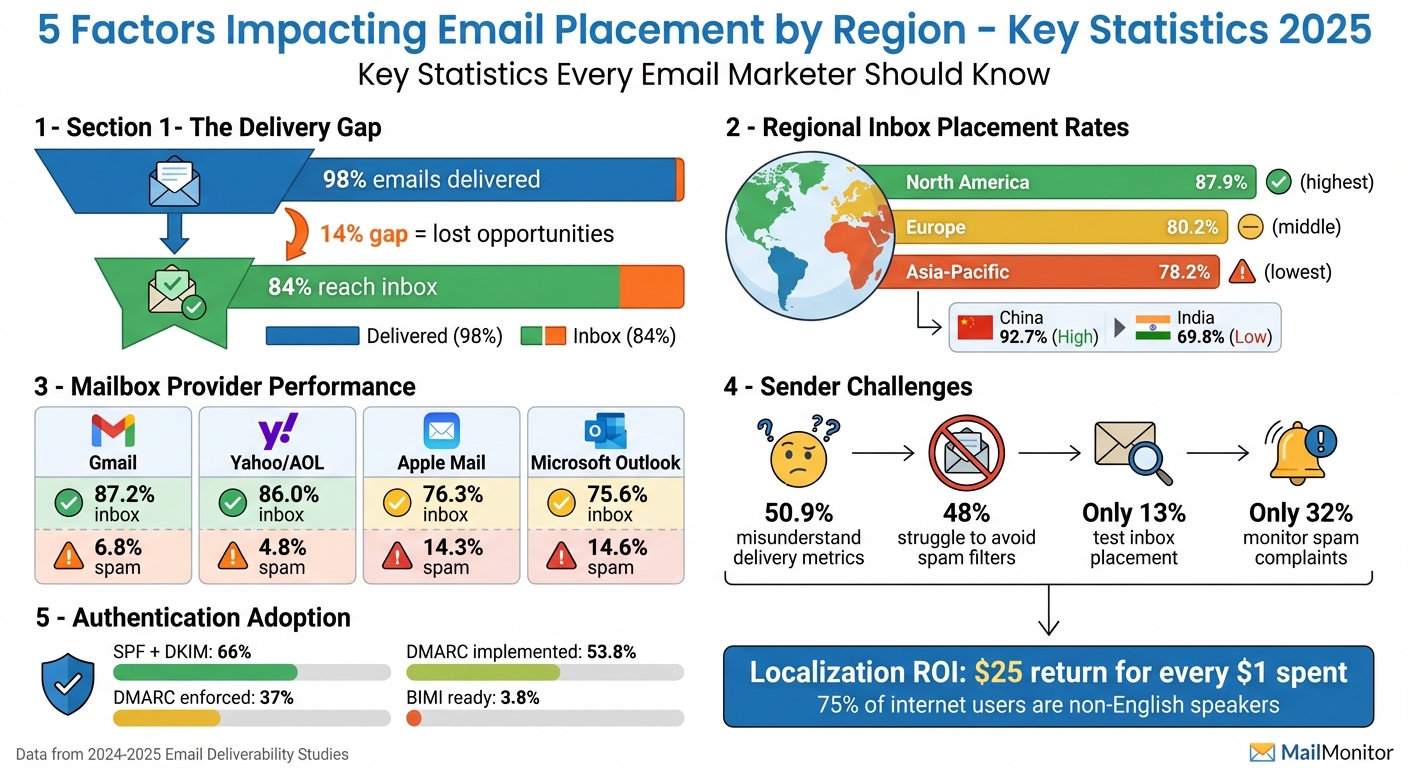
Email Inbox Placement Rates by Region and Provider 2025
How to Fix Your Email Deliverability & Land in the Primary Inbox
sbb-itb-eece389
1. ISP Filtering Policies and Adoption Rates
Internet Service Providers (ISPs) use different methods to filter emails, leading to noticeable regional variations in email placement. For instance, Gmail blocks over 15 billion spam emails daily [4]. Its filtering relies heavily on AI models that focus on metrics like email opens and clicks. On the other hand, Microsoft Outlook, which depends more on user feedback loops, has one of the lowest inbox placement rates at 75.6%, with spam rates exceeding 14% [3]. Apple Mail fares slightly better with a 76.3% inbox placement rate, boosted by its recent iOS 18 update introducing inbox categorization features [4]. These variations underline how filtering approaches directly impact email performance across regions.
Looking at regional trends, North America leads the way with an average inbox placement rate of 87.9% [3], largely due to the widespread use of authentication protocols like SPF, DKIM, and DMARC. In contrast, the Asia-Pacific region averages 78.2% [3], but country-specific differences are significant. For example, India records a lower average of 69.8%, while China achieves an impressive 92.7%, partly because of its state-regulated email systems. Europe, with its stricter GDPR compliance and higher engagement thresholds, lands in the middle with an inbox placement rate of 80.2% [3]. These stricter requirements often result in more aggressive filtering of promotional emails.
As of May 5, 2025, Microsoft has begun rejecting non-compliant bulk emails entirely, returning the error code "550 5.7.515" [4]. Google and Yahoo have also tightened their authentication requirements for bulk senders [4]. This shift makes robust email authentication a non-negotiable factor for achieving inbox access in developed markets.
Despite these challenges, only 13.3% of senders actively test inbox placement [2]. Meanwhile, 48% of senders cite avoiding spam filters as their biggest hurdle [2]. Tools like MailMonitor provide a way forward by offering actionable insights and seed testing to help senders navigate these obstacles effectively.
| Mailbox Provider | Inbox Placement | Spam Rate |
|---|---|---|
| Gmail | 87.2% | 6.8% [3] |
| Microsoft (Outlook) | 75.6% | 14.6% [3] |
| Yahoo / AOL | 86.0% | 4.8% [3] |
| Apple Mail | 76.3% | 14.3% [3] |
2. Regional Anti-Spam Regulations and Compliance
Regional anti-spam laws play a key role in determining whether your emails land in inboxes or get flagged as spam. For example, the European Union’s GDPR and Canada’s CASL require explicit opt-in consent before sending marketing emails. On the other hand, the US CAN-SPAM Act allows emails to be sent to anyone unless they opt out [5]. This difference between opt-in and opt-out policies directly impacts how aggressively Internet Service Providers (ISPs) filter emails in each region.
The time allowed for processing unsubscribe requests also varies widely. In Australia, businesses have 5 working days to honor unsubscribe requests, while the US and Canada allow up to 10 business days [5]. The EU’s GDPR mandates breach notifications within 72 hours if there’s a risk to individuals, whereas Brazil’s LGPD requires breach reporting within 3 business days [5]. Missing these deadlines can lead to your emails being blocklisted, which significantly hampers deliverability. Non-compliance with these timelines often triggers spam filters, further complicating email campaigns.
Violations of compliance standards are one of the fastest ways to get flagged as spam. If recipients find it difficult to unsubscribe, they may resort to marking emails as spam instead. This action sends a strong signal to ISPs, which results in future messages being redirected to junk folders. Industry data suggests that spam and bounce rates above 0.3% can harm deliverability, though staying below 0.1% is recommended for optimal inbox placement [2]. Moreover, privacy violations can lead to blocklisting, which completely prevents your emails from reaching recipients.
To ensure smooth compliance across regions, adopting the highest global standard is a wise choice. This includes adding a physical postal address (as required by CAN-SPAM and CASL), using RFC 8058-compliant one-click unsubscribe links, and maintaining detailed consent logs with timestamps and IP addresses [5]. This approach simplifies regulatory compliance and helps protect your sender reputation, no matter where your audience is located.
Here’s a quick look at key requirements across different regions:
| Requirement | EU (GDPR) | US (CAN-SPAM) | Australia (Spam Act) |
|---|---|---|---|
| Consent | Opt-in required | No opt-in required | Opt-in required [5] |
| Unsubscribe SLA | "Promptly" (unspecified days) | 10 business days | 5 working days [5] |
| Postal Address | Not expressly required | Mandatory | Not required [5] |
| Opt-out Link Life | Not specified | Not specified | Must work for 30 days post-send [5] |
3. User Engagement and Behavioral Signals
Internet Service Providers (ISPs) pay close attention to both your sender reputation and how recipients interact with your emails. Every action – whether it’s an open, click, reply, or even a deletion – plays a role in determining where your emails land. When subscribers actively engage with your emails, ISPs are more likely to deliver future messages to the primary inbox. On the flip side, actions like ignoring emails, deleting them without opening, or marking them as spam can result in stricter filtering. These behavioral patterns are especially critical when analyzing engagement trends across different regions.
According to research, 57.4% of senders use open and click rates as key indicators of deliverability[2]. These metrics don’t just measure success; they directly impact inbox placement algorithms. Among senders handling over a million emails, low engagement is often cited as a major hurdle in achieving inbox placement[2]. Additionally, high spam rates can harm consumer trust – 32.8% report frustration, and 10% say it erodes trust[2].
ISPs assign varying levels of importance to user actions. Positive actions like opens, clicks, replies, and even saving emails enhance your sender reputation, increasing the chances of landing in the primary inbox. On the other hand, actions such as deleting emails without opening, ignoring messages over time, or marking them as spam can harm your reputation, pushing future emails into spam folders. Unsubscribes fall into a gray area; they’re expected in small numbers, but unsubscribe rates exceeding 1% often signal issues with your content or email frequency[1][2].
The key to maintaining strong engagement lies in moving away from generic "batch-and-blast" campaigns. Instead, segment your audience based on behavior, such as topics they’ve clicked on, products they’ve purchased, or their recent activity[1]. This tailored approach keeps your messages relevant and helps maintain positive engagement signals across different regions. Before launching large campaigns, consider seed testing to see how ISPs respond to your emails[1][2].
| Signal Type | Specific Action | Impact on Placement |
|---|---|---|
| Positive | Open, Click, Reply, Save, Move to Folder | Boosts reputation; improves primary inbox placement. |
| Negative | Mark as Spam, Delete without Opening, Ignore | Harms reputation; increases spam folder filtering. |
| Neutral/Mixed | Unsubscribe | Normal in small amounts; high rates suggest relevance issues. |
4. Authentication Standards Implementation
Email authentication protocols – SPF, DKIM, and DMARC – have shifted from being optional best practices to essential requirements for bulk email senders. Providers like Gmail, Yahoo, and Microsoft now rely on these protocols to verify sender identities and protect domains from spoofing. This verification directly impacts whether emails land in the primary inbox or get filtered out.
Adoption of these protocols varies across regions, leading to differences in inbox placement rates. In North America, the inbox placement rate reaches an impressive 87.9%, followed by Europe at 80.2%, and the Asia-Pacific region at 78.2%[3]. At the national level, the disparity becomes even more striking. For instance, Australia and the UK boast deliverability rates above 98%, thanks to strict verification practices. Meanwhile, India averages only 69.8%, largely due to inconsistent authentication and heavy reliance on shared IP pools[3].
Looking at global adoption, 66% of senders use both SPF and DKIM, but only 53.8% have implemented DMARC – a notable improvement from 42.6% in 2023[6]. However, among those using DMARC, just 37% enforce it with a "Reject" or "Quarantine" policy, while 31.8% still use "p=none," which only monitors failures without taking corrective action[6]. As Marcel Becker, Senior Director of Product at Yahoo, explains:
"The end goal is ideally a policy of p=reject. That’s what DMARC is for. Ensuring that your domain cannot be spoofed and protecting our mutual customers from abuse."[6]
Proper implementation isn’t a one-and-done process; it requires ongoing maintenance. For example, only 12% of senders follow best practices for rotating DKIM keys every 6 to 12 months[6]. Without regular rotation, compromised keys can leave domains vulnerable to impersonation. To bridge the gap between implementation and performance, monitoring through seed testing is essential, especially for senders operating across multiple regions.
For global campaigns, seed testing can identify ISPs that block emails due to misconfigured authentication. This step is especially critical in emerging markets, where infrastructure issues can magnify the effects of missing or incorrect protocols. Tools like MailMonitor offer solutions such as DMARC monitoring and seed testing to help ensure emails consistently reach the primary inbox.
| Protocol | Function | Current Adoption |
|---|---|---|
| SPF | Specifies authorized IP addresses for a domain | 66% (with DKIM)[6] |
| DKIM | Uses cryptographic signatures to verify domain identity | 66% (with SPF)[6] |
| DMARC | Sets policies for handling SPF/DKIM failures | 53.8% overall; 37% enforcing[6] |
| BIMI | Displays verified brand logos in inboxes | 3.8% of domains are BIMI-ready[6] |
5. Localized Content and List Quality Practices
Sending generic emails to a global audience is a fast track to poor inbox placement. Here’s a staggering fact: 75% of internet users worldwide aren’t native English speakers[7]. Yet, many email campaigns treat localization as an afterthought, leading to lower engagement and, worse, more spam complaints.
Crafting content tailored to specific regions isn’t just a nice-to-have – it directly impacts engagement. Localized content resonates with subscribers, boosting interaction, which is a key factor for inbox placement. When emails are written in a subscriber’s native language and align with their cultural norms, engagement naturally climbs. On the flip side, irrelevant or poorly translated messages push recipients to hit the spam button. With the industry spam complaint threshold set at 0.3%[2], exceeding this can quickly land your emails in the junk folder. Alarmingly, only 32% of senders keep tabs on their spam complaint rates[2].
Localization goes beyond simple translation. For example, Italian subject lines tend to be longer than their English counterparts[7], which can lead to truncation and reduced open rates. Then there’s the technical side – using improper encoding can result in garbled text, making your emails look unprofessional and even triggering spam filters.
Maintaining clean email lists becomes even more crucial when working across multiple regions. Different countries exhibit unique engagement behaviors, and keeping inactive subscribers on your list harms your sender reputation with local ISPs. Despite this, 34% of senders say list hygiene is a major challenge[2]. But the effort pays off. Segmented, well-maintained lists tailored to regional preferences deliver better results. Consider this: 55% of consumers are more likely to buy when product descriptions are in their native language[7], and companies investing in localization report a return of $25 for every $1 spent[7].
Regional compliance is another cornerstone of successful email campaigns. For instance, in China, marketing emails must include an "AD" prefix in the subject line[7], while Australian campaigns require the sender’s Australian Business Number (ABN)[7]. Failing to meet these requirements can lead to automatic filtering by ISPs. Tools like MailMonitor can help identify these regional issues through seed testing, allowing you to address problems – like misconfigured content or poor list quality – before they hurt your email performance.
Conclusion
Email placement varies widely by region, requiring strategies tailored to specific geographic challenges. The five factors we’ve discussed – ISP filtering policies, anti-spam regulations, user engagement signals, authentication standards, and localized content practices – work differently depending on where your audience is located. For example, the differences between Europe and Asia-Pacific highlight how geography can directly influence email delivery success.
This isn’t a minor issue. Nearly 48% of senders identify staying out of spam folders as their primary challenge[2]. Ignoring regional nuances – whether it’s GDPR compliance in Europe, ISP filtering rules in North America, or tailoring content for audiences in Asia – puts your sender reputation and business outcomes at risk.
Addressing these challenges means more than just translating content. It requires a tactical approach: monitoring ISP filters, segmenting email lists, enforcing authentication protocols, and testing content performance. Yet, with only 13.3% of senders currently using inbox placement testing[2], many campaigns fail to achieve their global potential.
This is where tools like MailMonitor step in. By offering seed testing, reputation monitoring, and authentication verification, MailMonitor helps you detect and resolve placement issues before they escalate. Whether it’s a DMARC misconfiguration that hinders Gmail delivery in North America or poorly localized content that triggers spam reports in Europe, these insights can safeguard your sender reputation and improve email performance worldwide.
FAQs
How do anti-spam laws in different regions impact email deliverability?
Regional anti-spam laws are a cornerstone of effective email deliverability, setting clear boundaries that marketers must respect to avoid penalties and ensure their emails land in recipients’ inboxes. Take the U.S. CAN-SPAM Act, for example. It permits marketing emails but comes with strict rules: every email must include a clear way to unsubscribe, and opt-out requests must be processed within 10 business days. The stakes are high – violations can lead to fines of up to $53,088 per email, not to mention the damage to your reputation and email deliverability.
Canada’s CASL goes even further, requiring explicit consent before sending any commercial emails. The penalties for non-compliance are steep, pushing businesses toward practices like double opt-in and meticulous record-keeping to stay compliant. Failure to follow these laws can result in blacklisting or being blocked by Internet Service Providers (ISPs), which directly impacts whether your emails even make it to the inbox.
In short, understanding and following these regional regulations isn’t optional – it’s a necessity for protecting your sender reputation and keeping your emails where they belong: in front of your audience.
How does user engagement affect email placement?
User engagement plays a huge role in determining whether your emails land in the inbox or get stuck in spam or promotional folders. Metrics like open rates, click-through rates, and replies act as signals to mailbox providers, showing that your emails are relevant and trustworthy. This can boost your sender reputation and improve the chances of your emails reaching the inbox.
On the flip side, low engagement or negative actions – like spam complaints – can hurt your reputation and lower deliverability. Even small actions, such as moving emails between tabs in Gmail (e.g., from Promotions to Primary), can impact how future emails are categorized. To improve your email placement, focus on crafting content that grabs attention and keeping your email list clean and up-to-date.
Why is email authentication important for ensuring emails reach the inbox?
Email authentication is crucial for making sure your emails reach the inbox rather than getting stuck in the spam folder. It works by verifying the sender’s identity, which helps email providers trust your messages. This not only improves delivery rates but also protects your reputation as a sender.
Tools like SPF, DKIM, and DMARC play a big role here. These authentication methods tell email providers that your messages are legitimate, increasing the chances they’ll be successfully delivered.

