
When it comes to email marketing, email deliverability and open rates are two key metrics you need to understand. Deliverability ensures your emails land in recipients’ inboxes, while open rates measure how many people actually open them. These metrics are connected but require different strategies to improve.
Key Points:
- Email Deliverability: Focuses on technical aspects like sender reputation, email authentication (SPF, DKIM, DMARC), and list hygiene. Aim for a deliverability rate of 98–99%.
- Open Rates: Reflects engagement and depends on factors like subject lines, send timing, and audience segmentation. Average open rates across industries are around 41.3%.
Quick Facts:
- 1 in 6 emails never reaches the inbox.
- Poor deliverability reduces potential opens by 17%.
- Engaging content improves open rates but won’t matter without strong deliverability.
Takeaway: Prioritize deliverability first – if your emails don’t reach inboxes, they can’t be opened. Then, refine your content to boost engagement.
How To Improve Email Deliverability & Open Rates | Live Webinar
What is Email Deliverability?
Email deliverability is all about whether your emails actually make it into your recipients’ inboxes instead of getting lost in spam, promotions, or other folders. This is different from the delivery rate, which only tells you if the receiving mail server accepted your email without bouncing. Even if most of your emails are technically delivered, they won’t be effective if they end up in spam folders.
To aim for success, your email deliverability rate should ideally be between 98–99%, with 85% being the minimum benchmark. However, one in six emails still misses the inbox, and a whopping 45% of global email traffic gets flagged as spam. This shows just how strict filtering systems can be, and why simply getting your email accepted by a server isn’t enough.
Factors That Affect Email Deliverability
Several factors play a role in whether your emails land in the right place or not.
Sender Reputation. Email providers pay close attention to how people interact with your emails. High engagement (like opens, clicks, and replies) tells them your content is valuable, while low engagement or spam complaints can hurt your reputation. On top of that, email lists naturally decay by about 22.5% each year, so keeping your list clean is essential.
Email Authentication Protocols. These protocols verify that you’re a legitimate sender. For instance, emails that fail SPF checks are 30% more likely to end up in the spam folder. The key authentication methods – SPF, DKIM, and DMARC – work together to confirm your identity. Setting up DMARC can even boost your email conversion rates by up to 10%.
Content Quality and Relevance. If your emails look suspicious, they’re more likely to be flagged. In fact, 78% of people report emails as spam if they seem shady, and 54% do so if they didn’t give permission to be contacted. This makes it crucial to focus on crafting relevant, permission-based content.
Recipient Engagement. High engagement strengthens your sender reputation, while high unsubscribe rates can do the opposite. As Vineet Gupta, Founder of 2xSaS, puts it:
"A high unsubscribe rate indicates to mailbox providers that your content is irrelevant to your target demographic, leading to low email deliverability".
Technical Infrastructure. Factors like how many emails you send, the reputation of your IP address, and how you "warm up" a new domain all matter. For example, sending too many emails too quickly from a new domain can trigger spam filters. Gradually increasing your sending volume helps build trust over time.
Improving these areas is critical to ensuring your emails land where they’re supposed to. This is where tools like MailMonitor come into play.
How MailMonitor Improves Deliverability
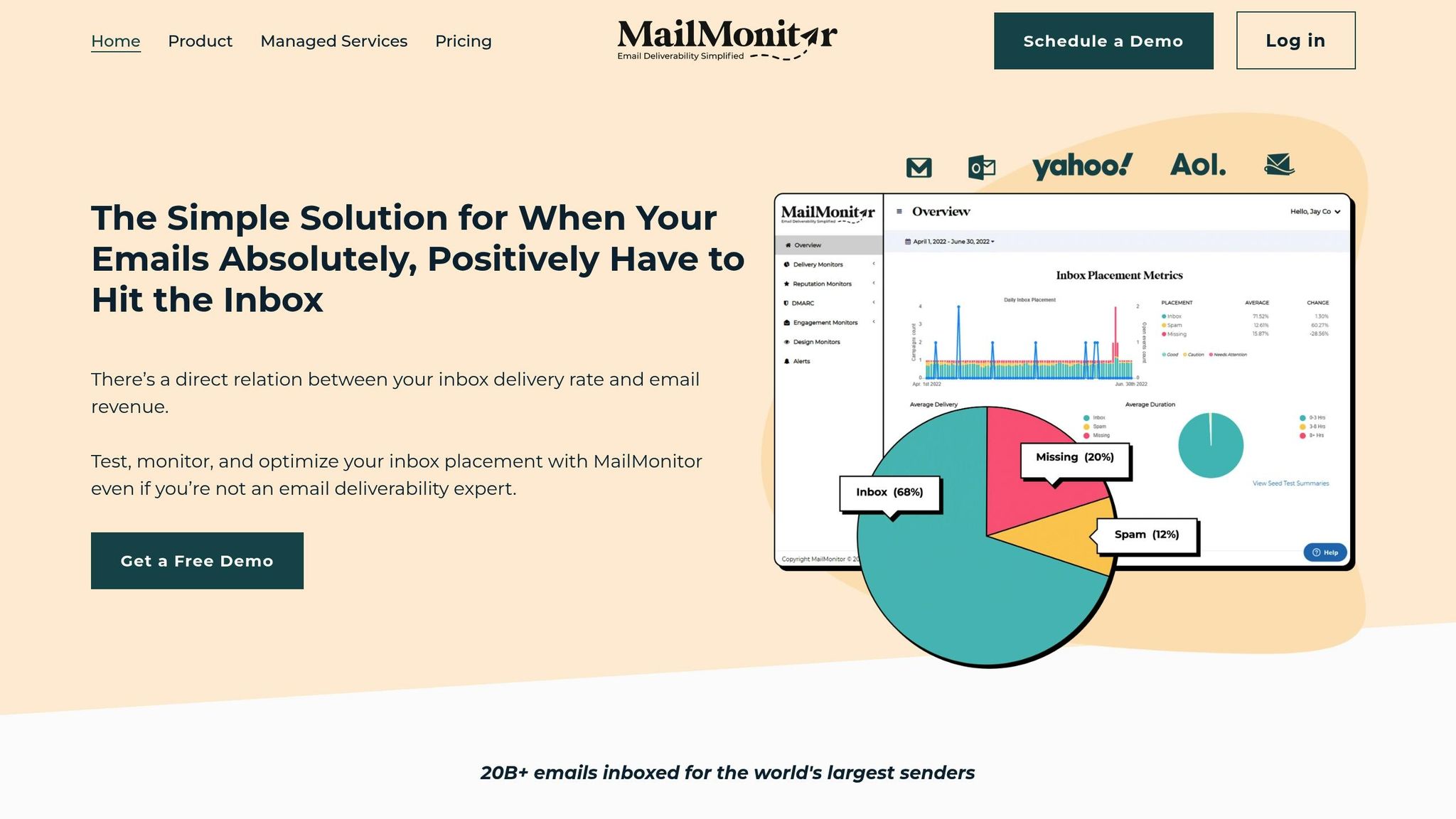
Addressing deliverability challenges requires tools that go beyond just reporting problems – they need to help you fix them. MailMonitor offers a suite of features designed to keep your emails on track and out of spam folders.
- Inbox Placement Testing. MailMonitor shows exactly where your emails land – be it the inbox, spam, or promotions – across major providers like Gmail, Outlook, and Yahoo. This lets you spot and fix issues before launching your campaigns.
- Real-Time Reputation Monitoring. It keeps an eye on factors affecting your inbox placement and alerts you to drops in reputation so you can act quickly.
- DMARC Implementation Support. Setting up SPF, DKIM, and DMARC can be tricky, but MailMonitor guides you through the process and continuously monitors their status.
- Deliverability Analytics. Get detailed insights into what’s working in your email strategy and what needs tweaking, so you can optimize your campaigns with data-backed decisions.
- Blacklist Monitoring. MailMonitor regularly checks major spam blacklists to catch and resolve any issues fast, helping protect your deliverability.
What is Open Rate?
Open rate is a key metric in email marketing that shows the percentage of recipients who opened an email out of the total number of emails successfully delivered. Here’s the formula:
Open Rate = (Number of Opens / Number of Delivered Emails) × 100.
Since "delivered emails" exclude those that bounced, this metric offers a clearer view of how many people actually interacted with your email. It’s a direct reflection of how well your subject line grabs attention and earns trust.
For reference, industry data from 2021 shows an average open rate of 21.5%. Certain industries, like Education, Agriculture, and Financial Services, often see higher rates – around 25–28%. On the flip side, an open rate below 10% is a red flag for poor performance .
More than just measuring who clicked to open, open rates provide insights into your campaign’s overall health. They can help assess the strength of your subject lines, the quality of your email list, and even signal potential issues. For instance, a sudden drop might indicate deliverability problems or a loss of subscriber interest, while a spike suggests your content is hitting the mark.
Now, let’s dive into what drives these open rates.
Factors That Affect Open Rates
Several factors influence whether your emails get opened or ignored:
- Subject Line Quality: A well-crafted subject line stands out in crowded inboxes. Testing different options through A/B testing can help you find what works best.
- Send Time Optimization: Timing matters. Sending emails when your audience is most active can improve visibility and engagement.
- Audience Segmentation: Personalizing your emails for specific groups within your list makes readers feel like the message is tailored for them, increasing open rates.
- Sender Name Credibility: People are more likely to open emails from a sender they recognize and trust. Consistently using a familiar sender name and delivering quality content builds that trust.
- List Quality and Hygiene: Keeping your email list clean and filled with engaged, permission-based subscribers ensures your emails reach the right audience.
Open Rate Tracking Limitations
While open rates offer valuable insights, they’re not without their flaws. For example, Apple’s Mail Privacy Protection (MPP) preloads email content – including tracking pixels – even if the recipient doesn’t actively open the email. With Apple devices accounting for about 52% of email opens in 2021 and Apple Mail holding a 58% market share as of May 2022, this has significantly impacted tracking accuracy.
The effects are clear: Omeda reported that average open rates nearly doubled after MPP launched. A 2022 study also found that 29% of email marketers noticed a negative impact from MPP, prompting 62% of them to shift focus to other performance metrics.
Other factors, like image blocking or email content caching by platforms like Gmail and Yahoo, also make it harder to gauge true engagement. Since pixel-based tracking was already imperfect, these changes have made it even less reliable.
As a result, many email marketers are now prioritizing alternative metrics, such as click-through rates, unsubscribes, bounce rates, and spam reports, to get a fuller picture of campaign performance. While open rates still play a role in spotting trends and testing subject lines, they’re just one piece of a larger strategy in email marketing.
sbb-itb-eece389
Email Deliverability vs Open Rates: Main Differences
Email deliverability ensures your messages land in inboxes rather than getting flagged as spam, while open rates measure how many recipients actually open those emails. In short, deliverability is about reaching the inbox, and open rates are about engagement. Without strong deliverability, even the most enticing email won’t get the chance to be opened.
Deliverability is the starting point – if your emails don’t make it to the inbox, open rates become irrelevant. That said, high deliverability doesn’t automatically translate to high open rates. Success requires a combination of technical precision and engaging content.
Here’s a telling statistic: 88% of email senders struggle to accurately define the delivery rate metric, yet 57% track open and click rates to determine if their emails are reaching recipients.
The strategies for improving these metrics differ significantly. Deliverability focuses on technical elements like maintaining a strong sender reputation, using proper authentication protocols (SPF, DKIM, DMARC), and keeping your email list clean. Open rates, on the other hand, depend on crafting compelling subject lines, offering valuable content, and building trust with your audience.
Side-by-Side Comparison
| Aspect | Email Deliverability | Open Rates |
|---|---|---|
| Definition | Measures if emails reach the recipient’s inbox | Measures the percentage of delivered emails opened |
| What It Measures | Technical success in transmission and inbox placement | Recipient engagement and interest in content |
| Typical Benchmark | Above 95% delivery rate | Around 41.3% across industries |
| Primary Focus | Technical setup, sender reputation, authentication | Subject lines, content quality, audience connection |
| Key Factors | SPF/DKIM/DMARC setup, list hygiene, sending patterns | Subject line appeal, send timing, segmentation |
| Measurement Stage | Initial delivery | Follow-up engagement |
| Improvement Strategy | Authentication protocols, reputation management, list cleaning | A/B testing subject lines, personalization, content optimization |
| Impact on ROI | Foundational – poor deliverability limits all efforts | Direct – higher opens drive clicks and conversions |
| Tracking Difficulty | Requires specialized tools for inbox placement tracking | Less reliable due to privacy changes |
Did you know that nearly 17.7% of legitimate, permission-based marketing emails never even make it to the inbox? That’s almost one in five emails lost at the deliverability stage. But here’s the kicker: improving inbox placement can boost email ROI by 20%. This shows just how critical it is to prioritize deliverability before worrying about engagement metrics like open rates.
By understanding these differences, you can allocate your resources more effectively. If your open rates are low, start by checking your deliverability. After all, if your emails aren’t reaching inboxes, tweaking subject lines or content won’t make much of a difference. This understanding lays the groundwork for strategies that improve both deliverability and open rates.
Up next, we’ll dive into actionable steps to enhance both metrics. Stay tuned!
How to Improve Both Deliverability and Open Rates
To maximize email marketing success, you need to tackle two key challenges: getting your emails into recipients’ inboxes and ensuring they actually open them. Here’s how you can address both.
Steps to Improve Deliverability
Authenticate your email domain using protocols like SPF, DKIM, and DMARC. These tools help internet service providers verify your identity, making your emails appear trustworthy. Without them, your emails might look suspicious and fail to reach inboxes.
"An IP reputation is hard to build, easy to lose, and hard to regain. Therefore, ensuring you are sending the best emails before they are sent will limit the damage caused, and monitoring, post-send, will allow fine-tuning – and it will allow you to know when further action needs to be taken to protect or improve your IP status." – Rob Pellow, Digital Experience Director at Armadillo
Refine your opt-in process by using double opt-in. This ensures your list is filled with people who genuinely want to hear from you. A smaller, engaged audience is far better than a large, uninterested one that might mark your emails as spam.
Keep your email list clean by removing inactive subscribers regularly. A sunset policy can automatically filter out users who haven’t engaged with your emails over a set period.
Track email performance metrics like bounce rates, spam complaints, open rates, and click-through rates. Tools like MailMonitor can help you monitor inbox placement and identify potential issues.
"Everyone’s goal is obviously 100%. What we focus on is our inbox placement. We want 100% of our emails getting to the inbox, and if it drops below 90%, we’re going to immediately investigate what’s going on. Deliverability is a measure of the health of your email marketing program, so it’s important to do regular check-ups on your domain, IP, and authentication in particular to make sure you’re up-to-date, just like how we all go to the doctor each year." – Carin Slater, Manager of Lifecycle Email Marketing at Litmus
Manage your sending volume wisely. For large campaigns, use a dedicated IP address and gradually increase your email volume. This helps avoid spam filters and builds a positive sender reputation.
Once your technical setup is solid, it’s time to focus on creating content that drives engagement.
Ways to Boost Open Rates
Write irresistible subject lines. Nearly half of recipients decide to open emails based on subject lines alone, while 69% mark emails as spam for the same reason. Keep them short, intriguing, and free of spammy language.
Segment your audience to send more relevant content. Group your subscribers by demographics, purchase history, or engagement levels. Segmented campaigns see 14% higher open rates and 101% higher click-through rates compared to general ones.
Personalize your emails by using details like purchase history or browsing behavior. Personalization can increase open rates by 26%.
Test everything. A/B testing subject lines, sender names, and preheaders can reveal what works best for your audience. Even small changes can lead to noticeable improvements.
Send emails at the right time. Analyze when your audience is most active and schedule emails accordingly. Timing can make a big difference in open rates.
Offer a preference center so subscribers can choose how often they hear from you. This reduces unsubscribes and spam complaints while keeping your most engaged readers happy.
"You’re a guest in your subscriber’s inboxes, so respect what they have told you. Whether that’s their overall preferences and topics, or if they say they want their emails in Dark Mode, or they sign up for your newsletter and nothing else, you have to honor that." – Carin Slater, Manager of Lifecycle Email Marketing at Litmus
By combining these strategies, you can create a cycle of engagement that strengthens your reputation over time.
Using a Combined Approach
The most successful email campaigns balance technical precision with engaging content. Deliverability and open rates are deeply connected – high engagement reinforces your sender reputation, which in turn improves deliverability.
Start with the basics: authenticate your domain, clean your email lists, and monitor your metrics. Then, focus on crafting content that resonates with your audience. Tools like MailMonitor provide insights into both inbox placement and engagement, helping you fine-tune your strategy.
For example, Glassdoor achieved impressive results by combining these tactics. With proper authentication and dedicated IP addresses, they reached a 99.5% average monthly delivery rate, a 0.007% spam rate, and 30% unique open rates for high-volume campaigns.
"Deliverability is more of an art than a science – the landscape is constantly changing." – Nonso Maduka, Director of Product Management at Glassdoor
Aim for at least 85% deliverability (with 98–99% being ideal) and open rates between 19–25%, depending on your industry. Consistent monitoring and optimization are key. Use tools like MailMonitor for reputation tracking and alerts, and keep testing and improving your content. This approach ensures your emails not only land in inboxes but also drive the engagement you need for long-term success.
Conclusion
Let’s wrap this up with a key takeaway: email deliverability ensures your messages land in inboxes, while open rates measure how engaging those messages truly are.
The numbers tell the story. Higher Logic boasts an impressive 99% email deliverability rate, far exceeding the industry average of 83.1%. Meanwhile, average open rates have slipped from 38.18% in 2023 to 35.64% in 2024. This downward trend highlights why fine-tuning your email strategy is critical to staying ahead.
"First, a strong email deliverability rate means more messages reach your contacts’ inboxes. That means more potential for opens, clicks, engagement, registrations, and revenue." – Higher Logic
Here’s the cycle: strong engagement boosts your sender reputation, which in turn improves deliverability. Better deliverability then creates more chances for engagement. Automated campaigns are a great example – these achieve a 38.10% open rate compared to 33.25% for single email blasts. Why? Because strategic segmentation and personalization make all the difference. It’s a clear reminder that technical precision and compelling content need to go hand in hand.
"Overall, to ensure a successful email campaign, don’t just focus on email deliverability. Focus on email open rates as well." – Mike Khorev
Tools like MailMonitor’s inbox placement tests, reputation tracking, and DMARC support provide the insights you need to refine both delivery and engagement.
At its core, successful email marketing is about mastering this balance – getting your emails delivered and ensuring they resonate with your audience. Every strategy we’ve explored ties back to this essential principle.
FAQs
What are the best ways to improve email deliverability and ensure your messages reach the inbox?
To ensure your emails land in inboxes rather than spam folders, start by using SPF, DKIM, and DMARC protocols. These authentication tools confirm your emails are legitimate, making it less likely they’ll be flagged as spam. If you’re working with a new domain, take the time to gradually warm up your IP address before sending large volumes of emails.
Keep your email list clean and up-to-date by removing invalid or inactive addresses regularly. This not only helps maintain a strong sender reputation but also boosts your chances of high deliverability. Pay close attention to your email performance and sender reputation to catch and resolve problems early. For reference, a good deliverability rate usually falls between 90% and 98%, signaling effective email practices.
What factors affect email open rates, and how can I improve them?
Email open rates hinge on several important factors, such as subject lines, sender reputation, personalization, timing, and the quality of your email list. If you’re looking to boost those rates, here are some practical tips:
- Craft subject lines that are clear, engaging, and concise. Aim to spark curiosity or highlight a benefit.
- Add a personal touch by including recipient names or tailoring content to their interests.
- Schedule emails to hit inboxes when your audience is most likely online and ready to engage.
- Keep your email list in top shape by removing inactive subscribers regularly.
- Safeguard your sender reputation by sticking to email best practices and steering clear of spam triggers.
By zeroing in on these techniques, you’ll not only grab your audience’s attention but also encourage them to open your emails, paving the way for stronger engagement and better marketing outcomes.
How do SPF, DKIM, and DMARC help improve email deliverability?
Email authentication is crucial for ensuring your messages are trusted and delivered effectively. Three key protocols – SPF, DKIM, and DMARC – work together to achieve this.
- SPF (Sender Policy Framework) checks whether the sender’s IP address is authorized to send emails for your domain.
- DKIM (DomainKeys Identified Mail) adds a digital signature to your emails, verifying their authenticity.
- DMARC (Domain-based Message Authentication, Reporting, and Conformance) ties SPF and DKIM together, providing an extra layer of protection against spoofing and phishing attacks.
Using these protocols not only boosts your sender reputation but also reduces the risk of your emails landing in spam folders. This means a better chance of your messages reaching your audience’s inboxes.

